

Beyond the Spear: Legacy, Tradition, and Restoration of Sturgeon on Black Lake
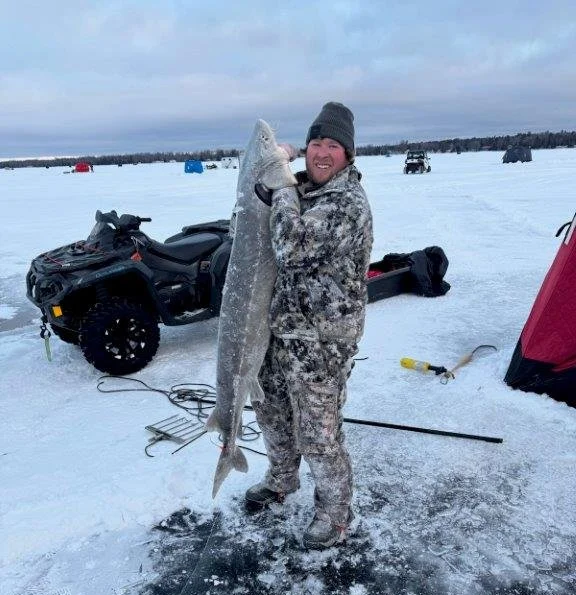
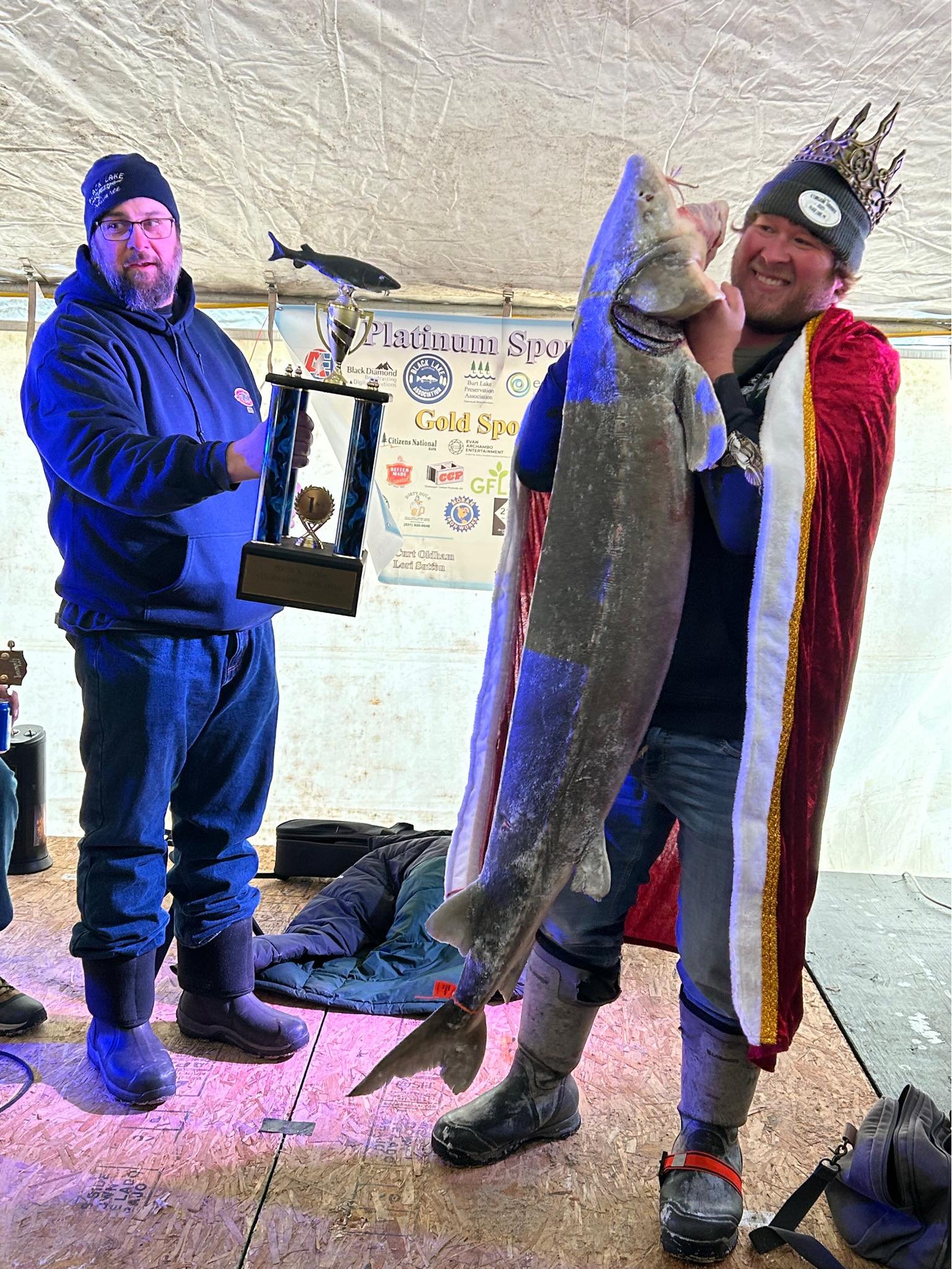
Austin Dreifuerst, shows off the biggest sturgeon speared in the 2025 season, earning him the title of sturgeon king. This tagged female was 64” and 78.3Lbs.
The world of outdoor adventures is filled with special opportunities, some more unique depending on regional availability. The draw of ice fishing brings a crowd for many across the north for winter fishing adventures. Black Lake in northern Michigan is home of the shortest fishing season in the world, along with the opportunity to connect with a big fish that tells a story of history, tradition, and culture. Locals, experienced anglers, and people far and wide will agree that there is nothing like sturgeon spearing.
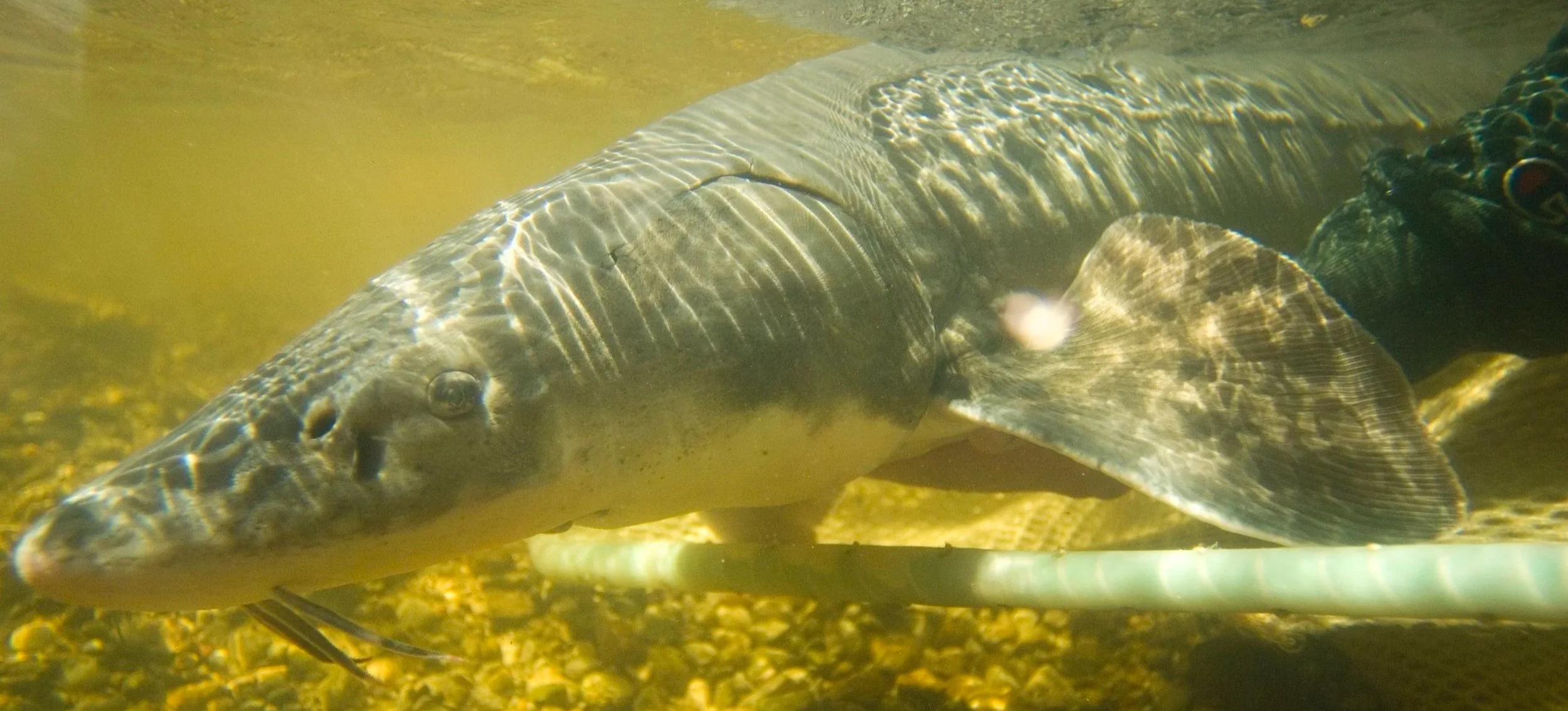
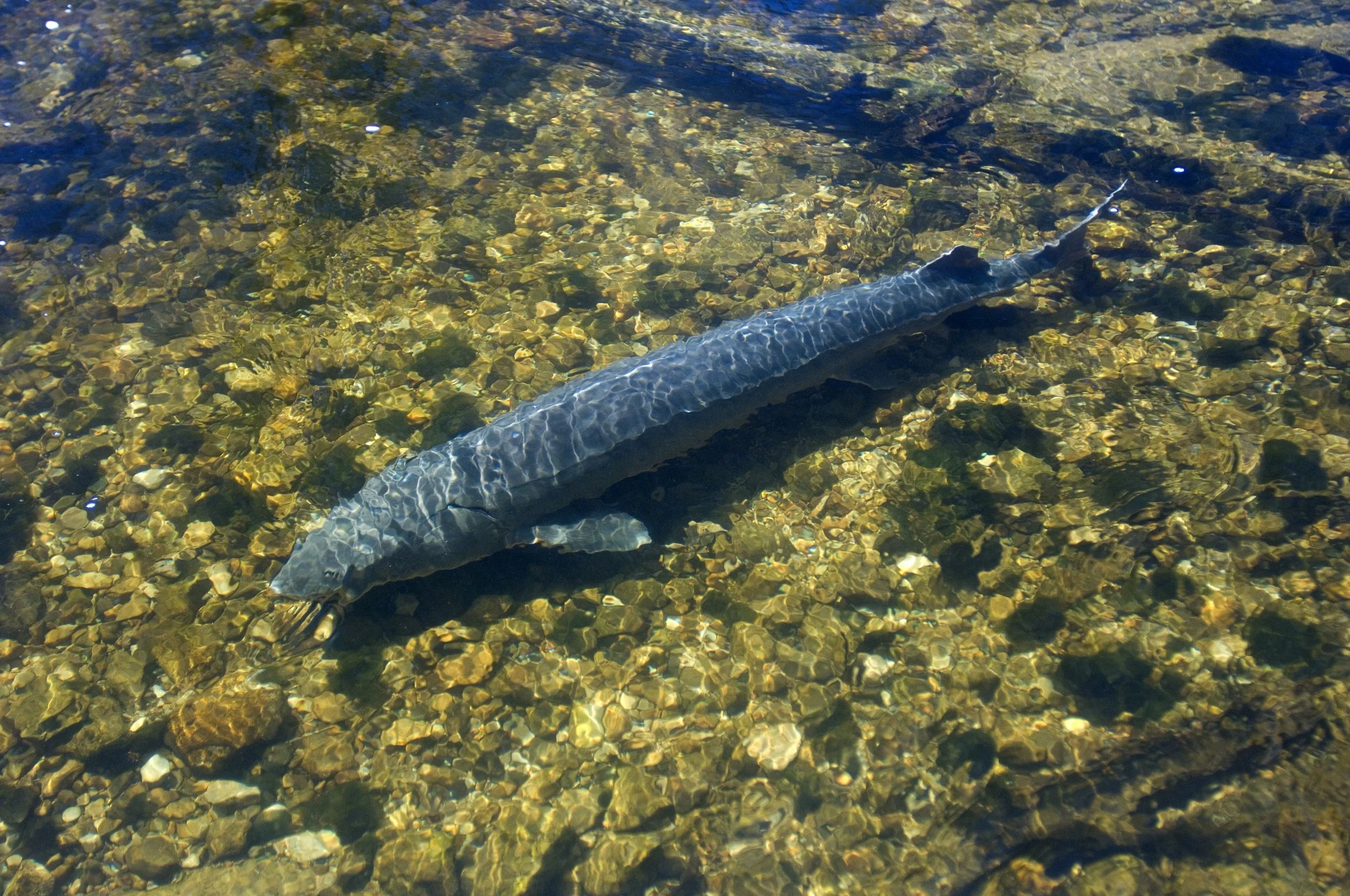
Photo Courtesy of Michigan Dept. of Natural Resources.
Sturgeon are truly unique in the realm of fish diversity. Growing to massive size, being armored with plates, and beyond powerful, there is no mistaking one for something else. A gentle giant, these creatures are bottom feeders in need of a high-protein diet. Scouring the bottom of lakes and rivers for aquatic macroinvertebrates (mussels, worms, crayfish, snails) and small dead fish. Using barbels (whiskers) to locate food on the bottom, they vacuum up food with their toothless, sucker-like mouths.
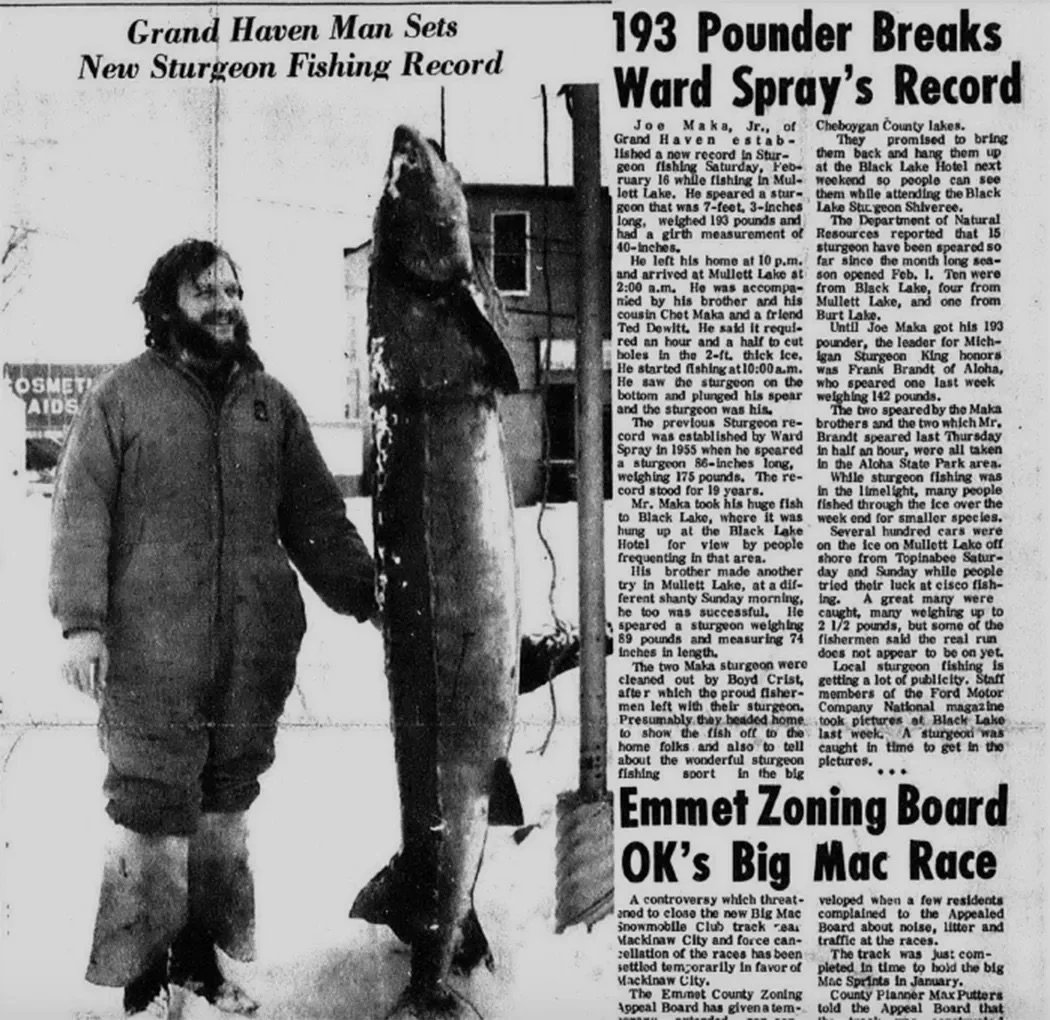
Joe Maka Jr posing next to the Michigan record Sturgeon of 193Lbs he speared on nearby Mullet Lake. (Cheboygan Observer, Feb. 1974)
There are five species of sturgeon found in North America. The Great Lakes are home to lake sturgeon, as they have been living here dating back to when the lakes were formed after glacial ice melted thousands of years ago. The current state record of Michigan is a monumental 193lbs that was speared out of Mullet Lake in 1974.
The allure of spearing sturgeon though the ice brings in a special collection of dedicated enthusiasts. There are only two opportunities in the United States where sturgeon spearing is permitted, Lake Winnebago, Wisconsin, and Black Lake, Michigan. Many of the ‘die-hard’ spear fishermen will visit both lakes for the chance. There is more than what meets the eye beyond the spear. A culture and a fandom behind supporting this long-standing winter Tradition.
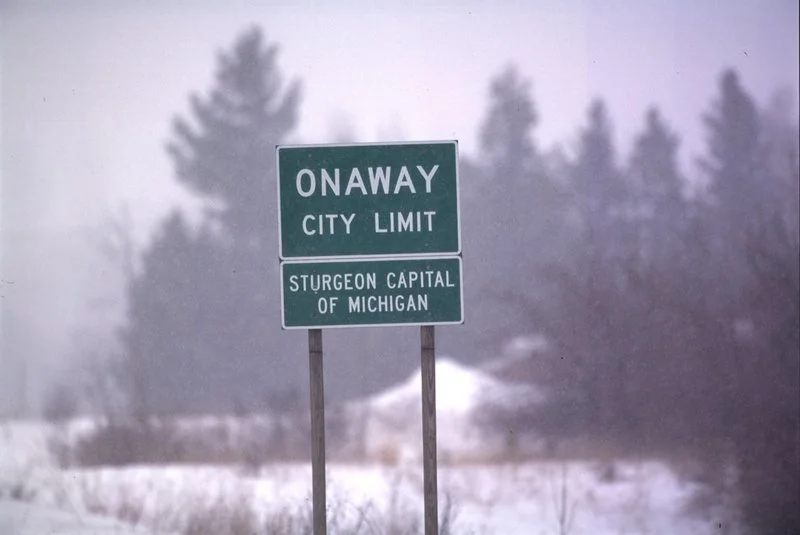
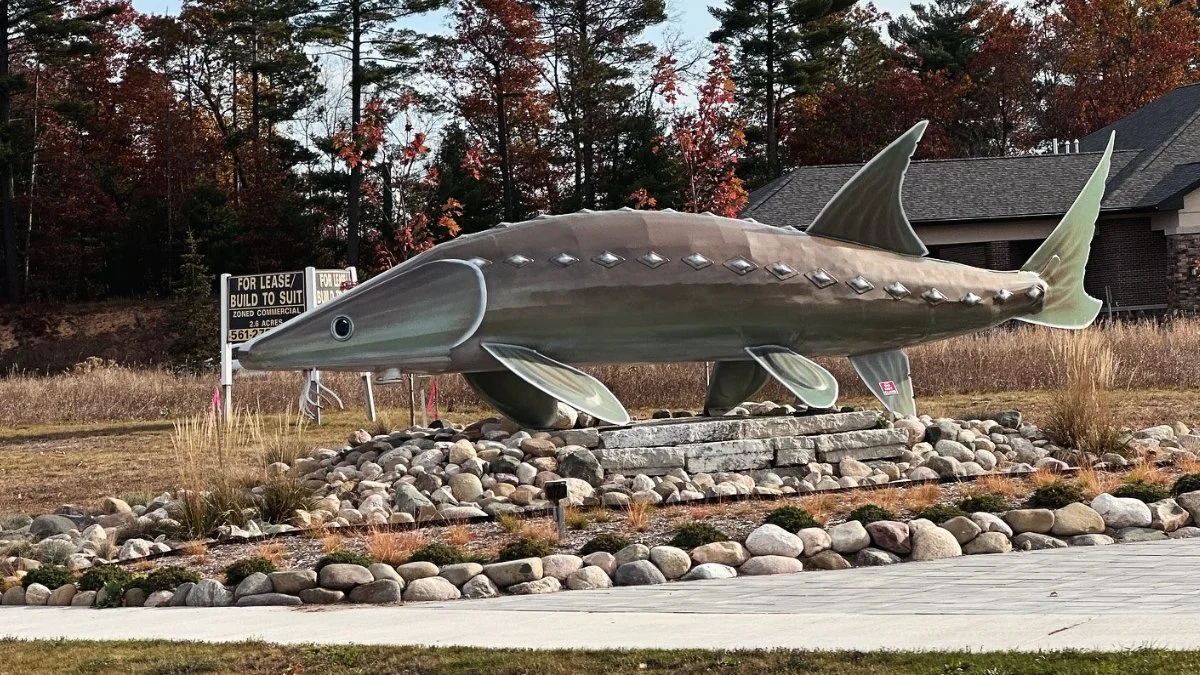
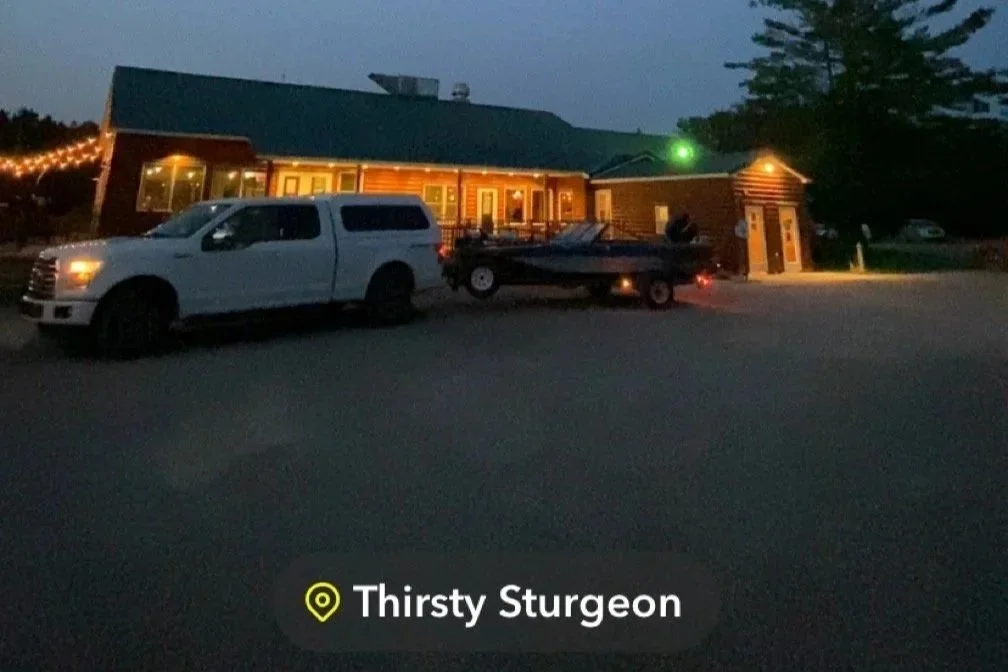

Exploring the area, one could tell that there is very much an apparent culture and appreciation for these fish across the communities in the Northern lower peninsula. Onaway, known as the Sturgeon Capitol of Michigan, is home to Black Lake and the streamside rearing facility and sturgeon hatchery. Twenty miles west of Onaway, there a 32’ steel statue of a lake sturgeon where highway 68 and old US 27 intersect in Indian River. This statue was made by Moran Iron Works with Students from the Industrial Arts Institute and donated to serve as a tribute to honoring the sturgeon tradition and commitment. Up stream from this location towards Wolverine, there is the Thirsty Sturgeon, an amazing restaurant dedicated to the lore and decorated with historic relics and photos.
Meet the Woiderskis: A Family of Heritage in Sturgeon and Spearing
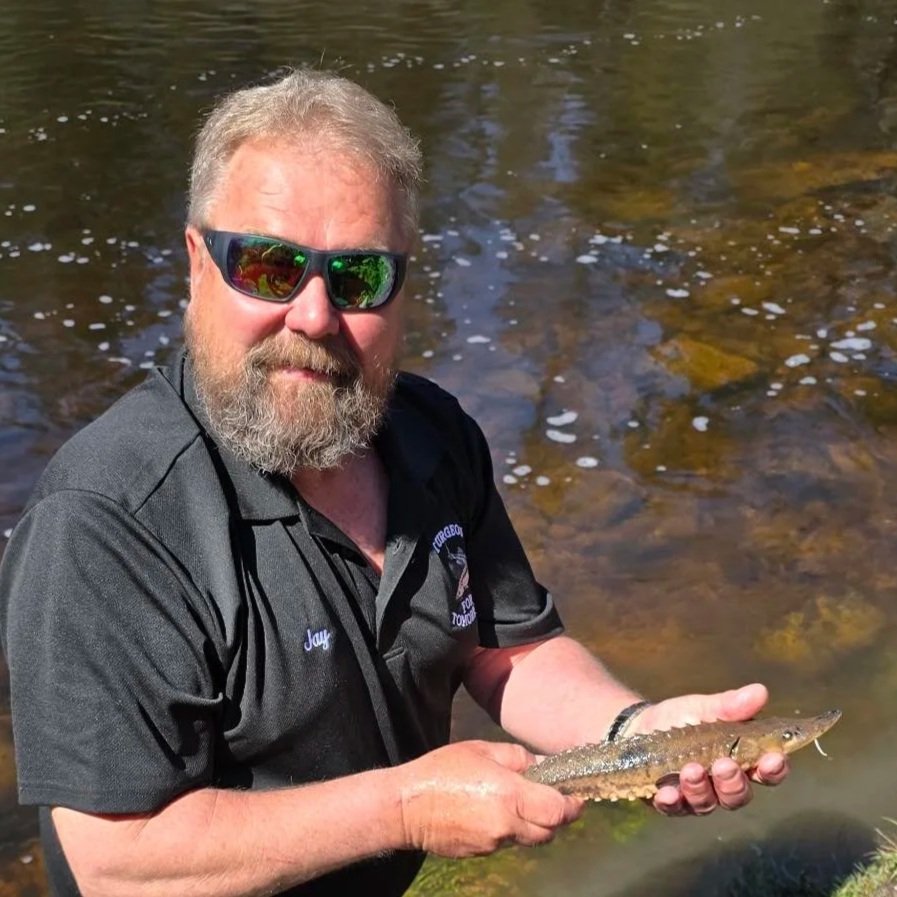
Jay Woiderski, President of the Sturgeon for Tomorrow: Black Lake Chapter, is passionate about efforts supporting sturgeon restoration.
Tradition cannot live on without people. Dedicated volunteers and stewards, made up of many backgrounds and expertise, all take part in credit for the current success of Sturgeon in the area. Among them, the Woiderski family has made an invaluable contribution to the sturgeon’s story for generations.
Jay Woiderski, President of the Sturgeon for Tomorrow: Black Lake Chapter, is a life-long resident of Cheboygan and avid outdoors man. He has deep family roots to the area and this tradition. He is the 3rd of 4 generations in his heritage to have speared a sturgeon over 100 lbs.
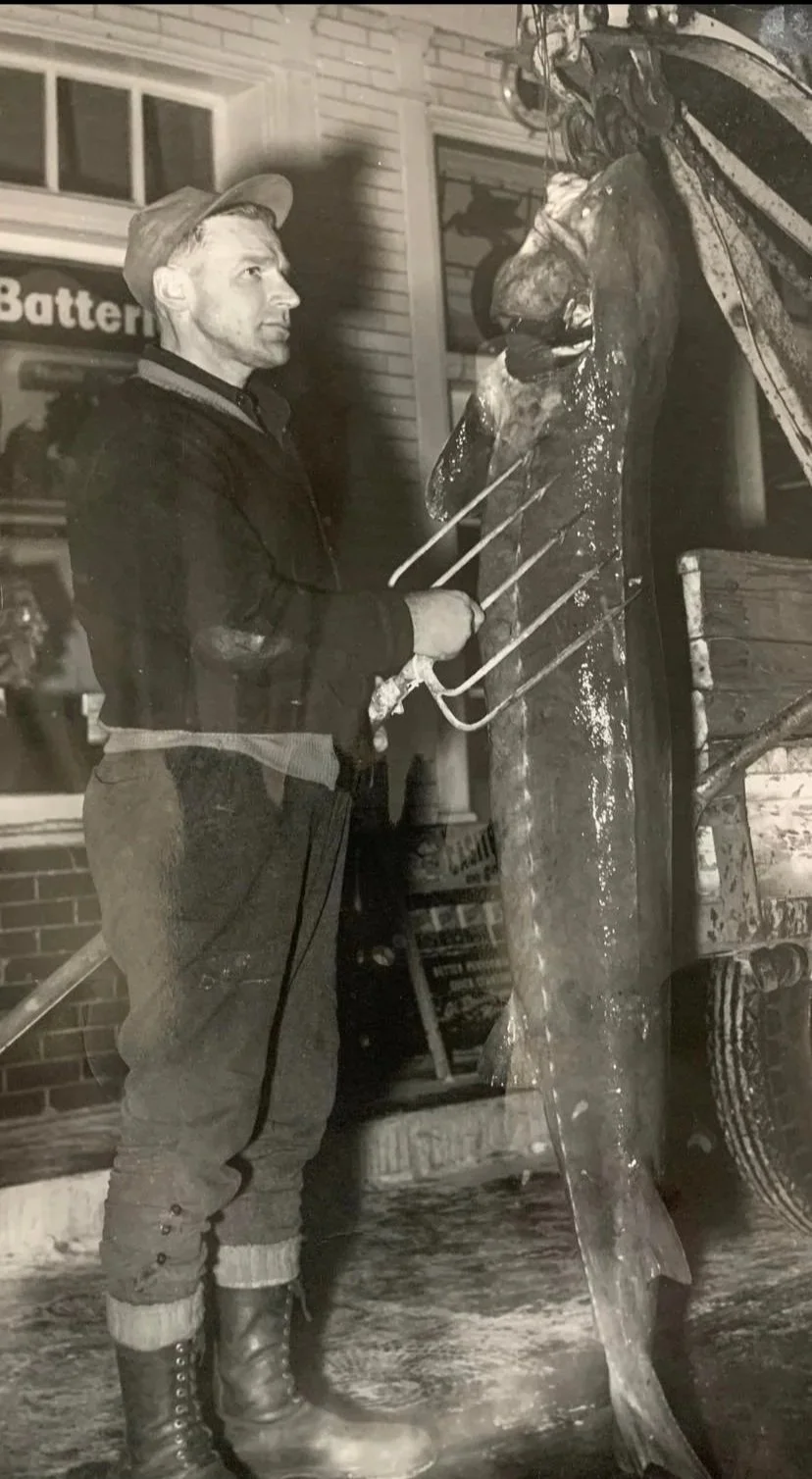
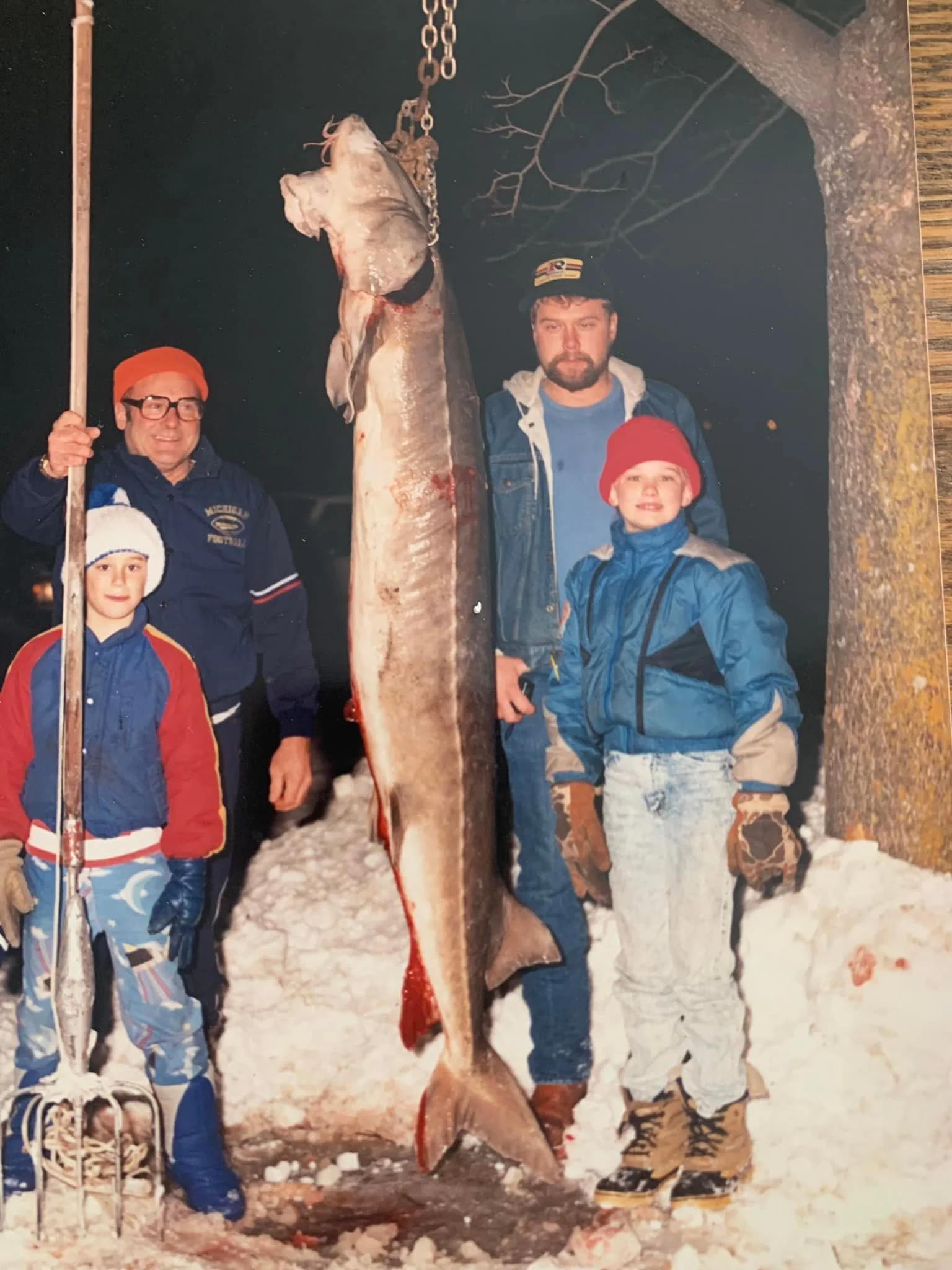
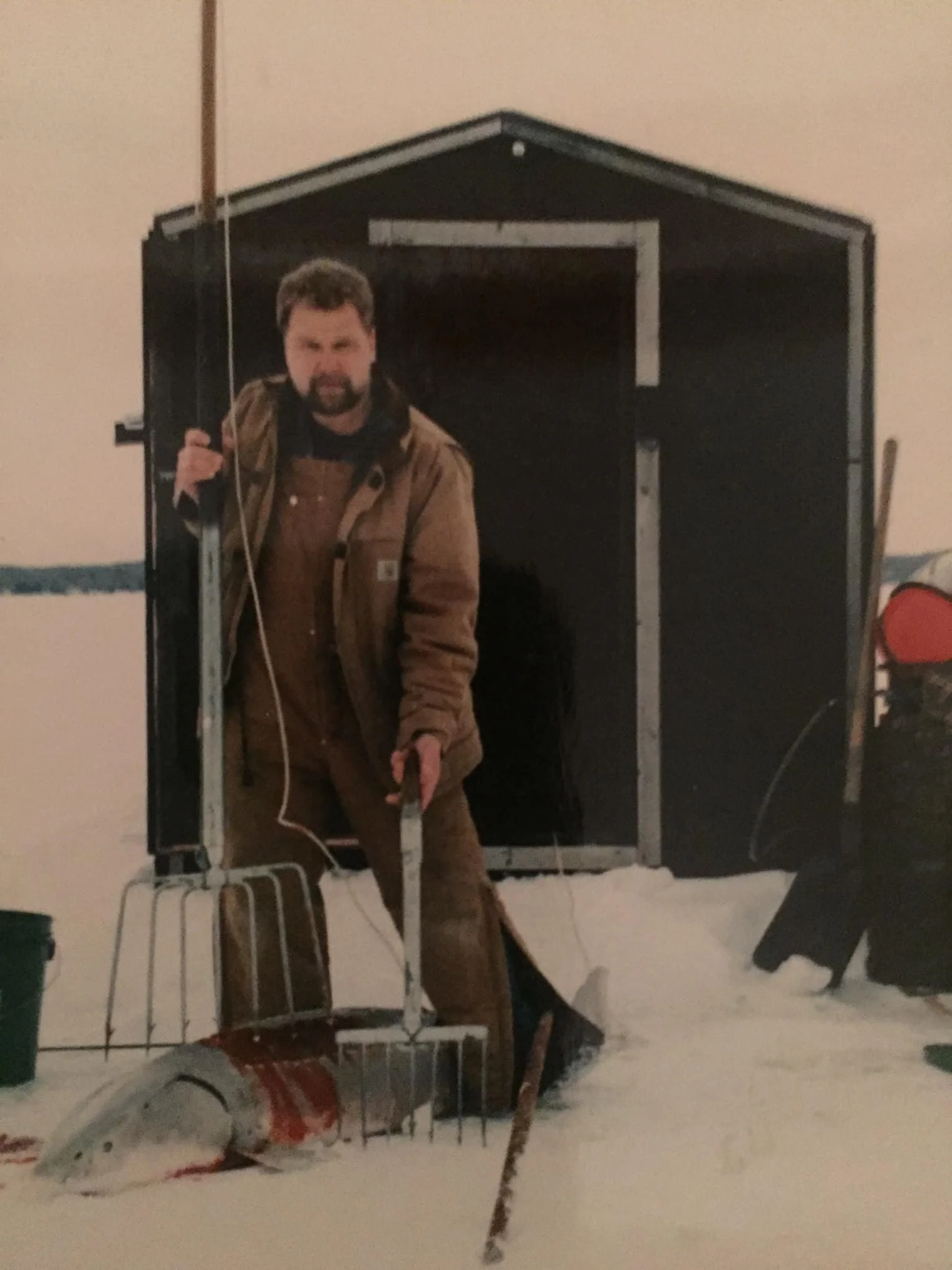
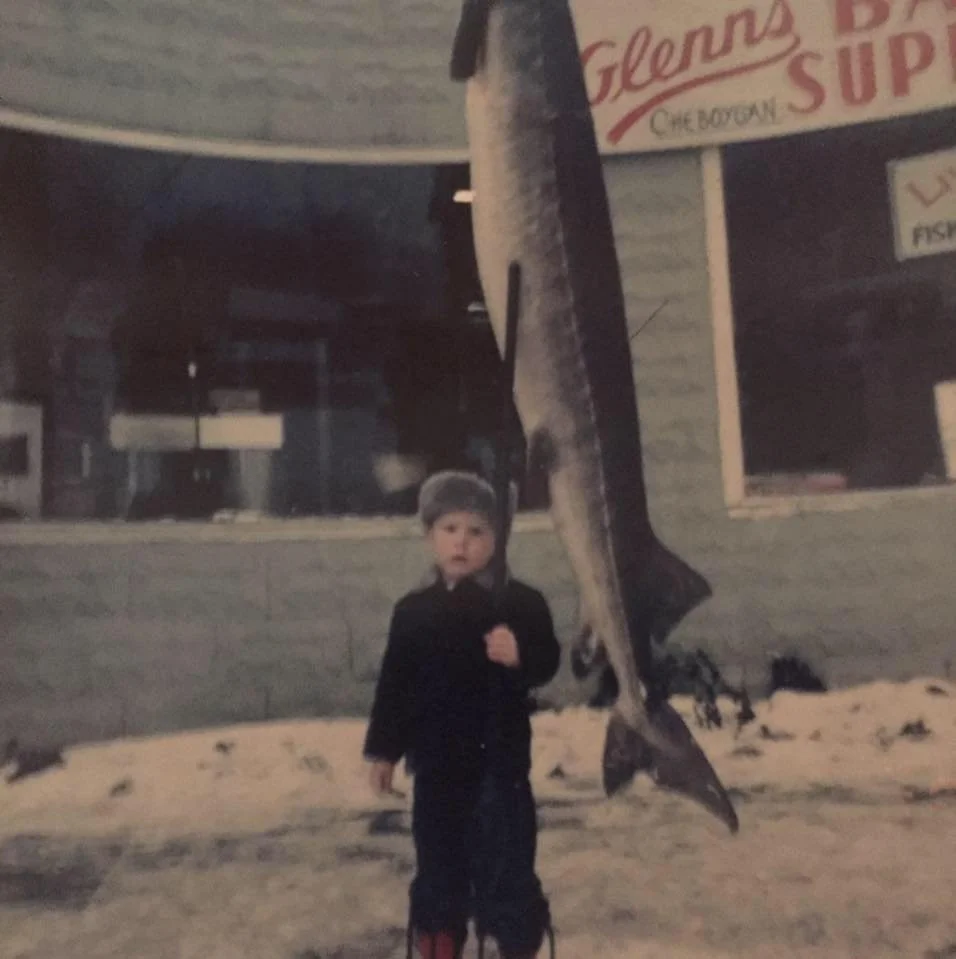
Above: Upper left: Jay’s grandfather, Bob Woidserski; upper right father, James Woiderski; lower left: Jay with his personal best sturgeon speared; lower right: 7 year old Jay posing with a giant sturgeon speared long ago. (Photos Courtesy of Mr. Jay Woiderski)
“My family was a part of the sturgeon spearing season when it began in 1948 so it has been a part of my life as long as I have been alive.”
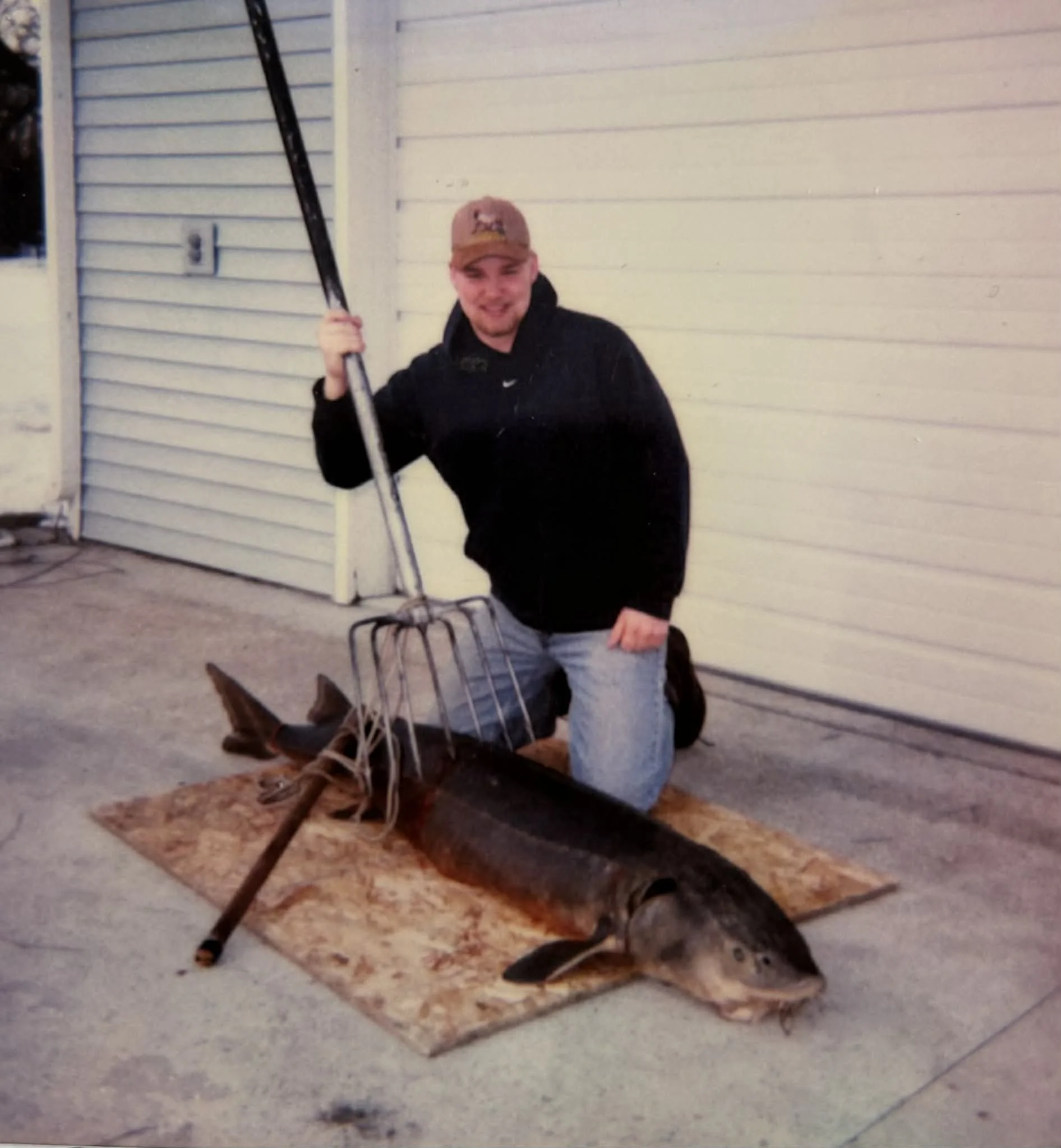
Jason Woiderski, is the 4th generation of sturgeon spear fishermen in his lineage, carrying on tradition.
He shares that there is a sense of camaraderie and purpose-driven mission. This project of rehabilitation of Lake Sturgeon and keeping a season going is very important to himself and others people that have been involved over many years. The sturgeon spearing community is well-connected by those who share a love for the chase and supporting the future of the fishery.
Of Tradition and History
Legends of the great sturgeon go back hundreds of years in Northern Michigan. The Anishinaabe people share lore and connection to these fish as a sacred protector and as the king or grandfather fish. The Odawa, Ojibwe, and Potawatomi, collectively known as the people of the Three Fires, were the first people of the Great Lakes. Their deep history is intertwined with the lake sturgeon.
Referred to as Nmé (pronounced “Nah-May) in native language, the Sturgeon represent these people as they have been around the great lakes for a long time as well. Fish were harvested for their meat for consumption, oil for lamp fuel, and the skin/hide for as material. In native culture, the springtime is a season of renewal and replenishment. After surviving a hard winter, they would fish for the sturgeon in spring to replenish themselves.
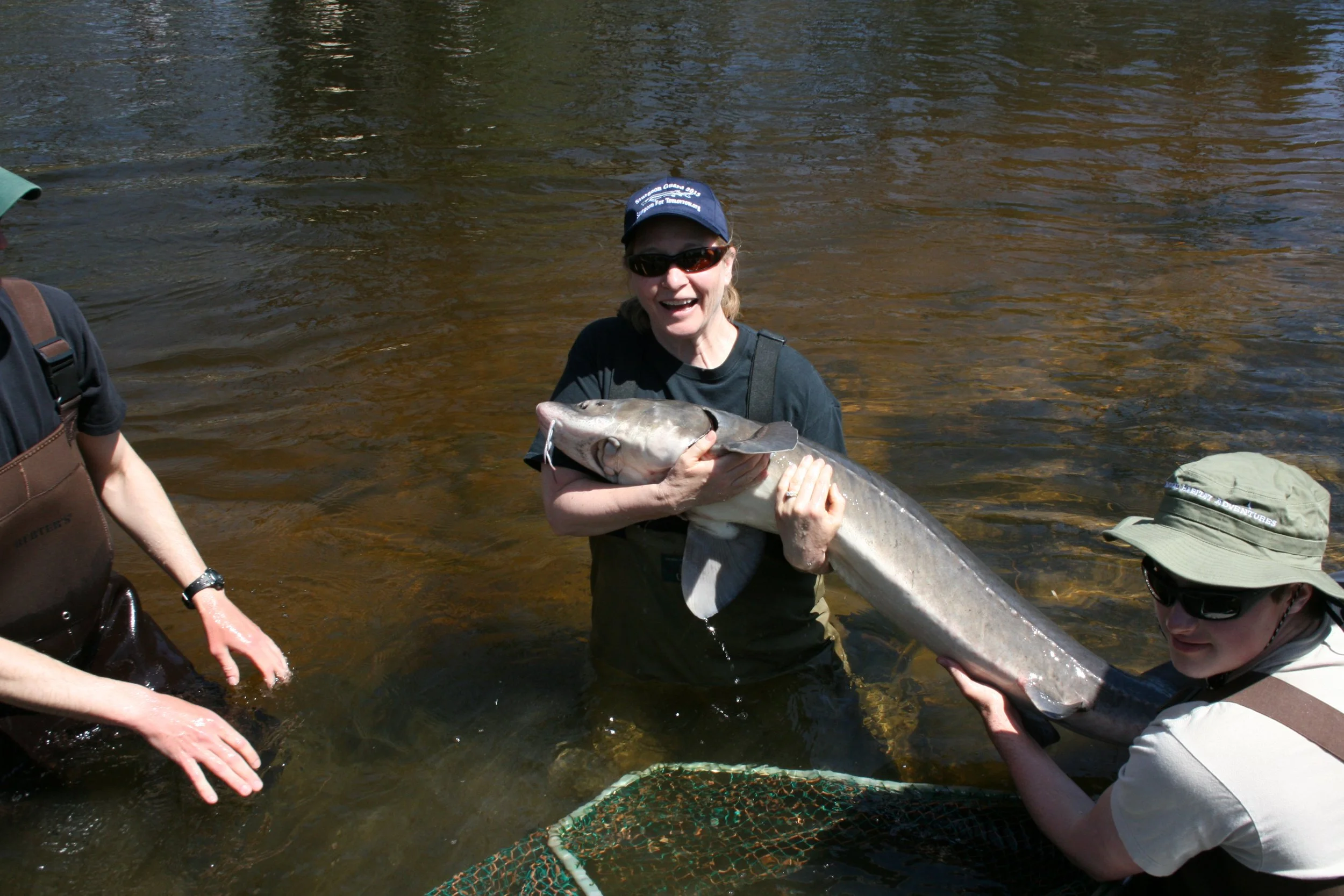
Above: Sheryl Marsh, co-owner of the Thirsty Sturgeon restaurant, is a member of Sturgeon for Tomorrow and volunteers in projects.
In the 1800’s, the sturgeon were seen as a nuisance fish because they would destroy nets and commercial fishing gear. When the economic value was recognized for their meat, oil, and caviar, they became overharvested quickly. Historical entries show that 8.6 million pounds of sturgeon were harvested in the Great Lakes in 1885. A century later, the population had crashed by 80%.
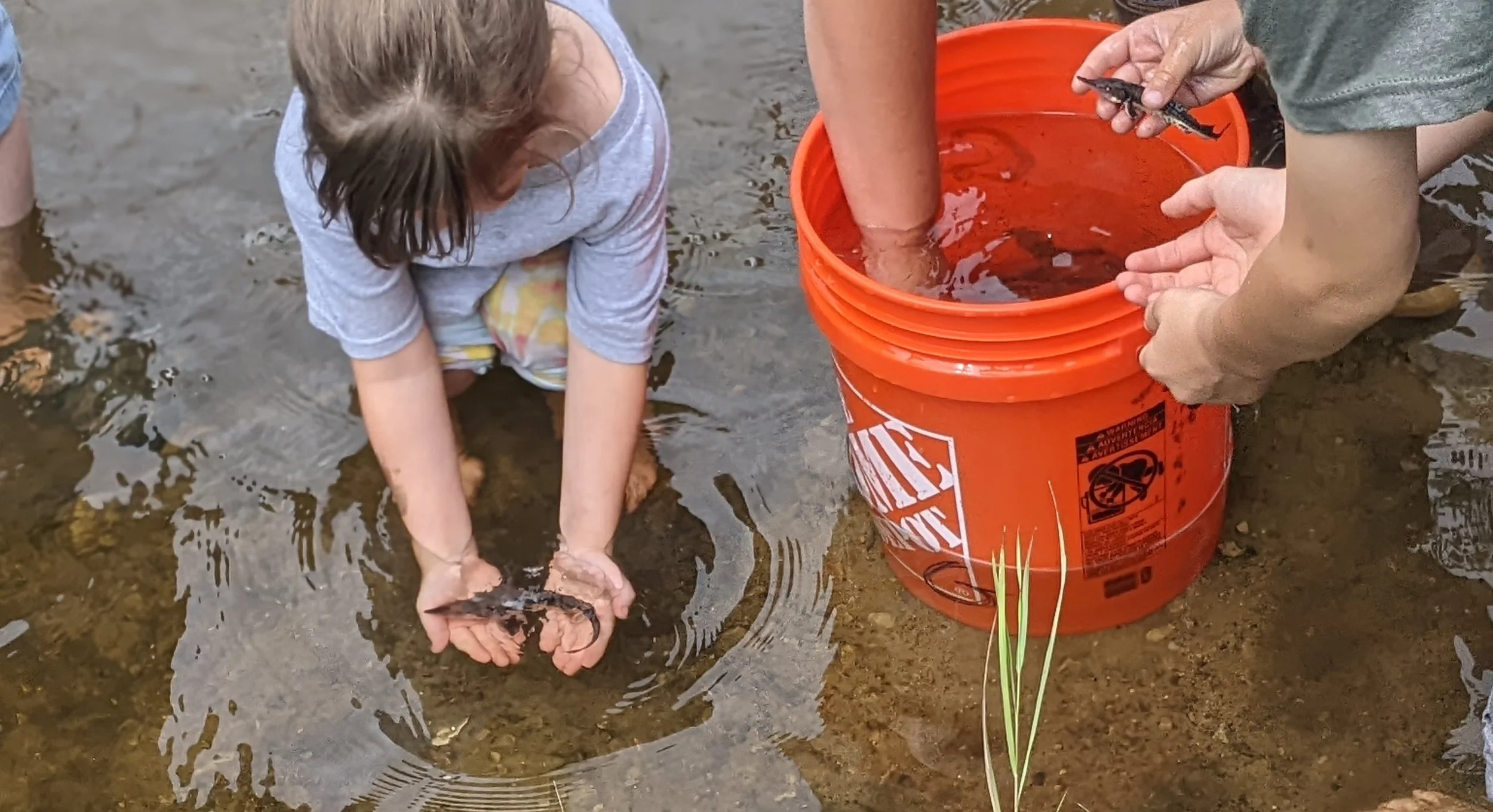
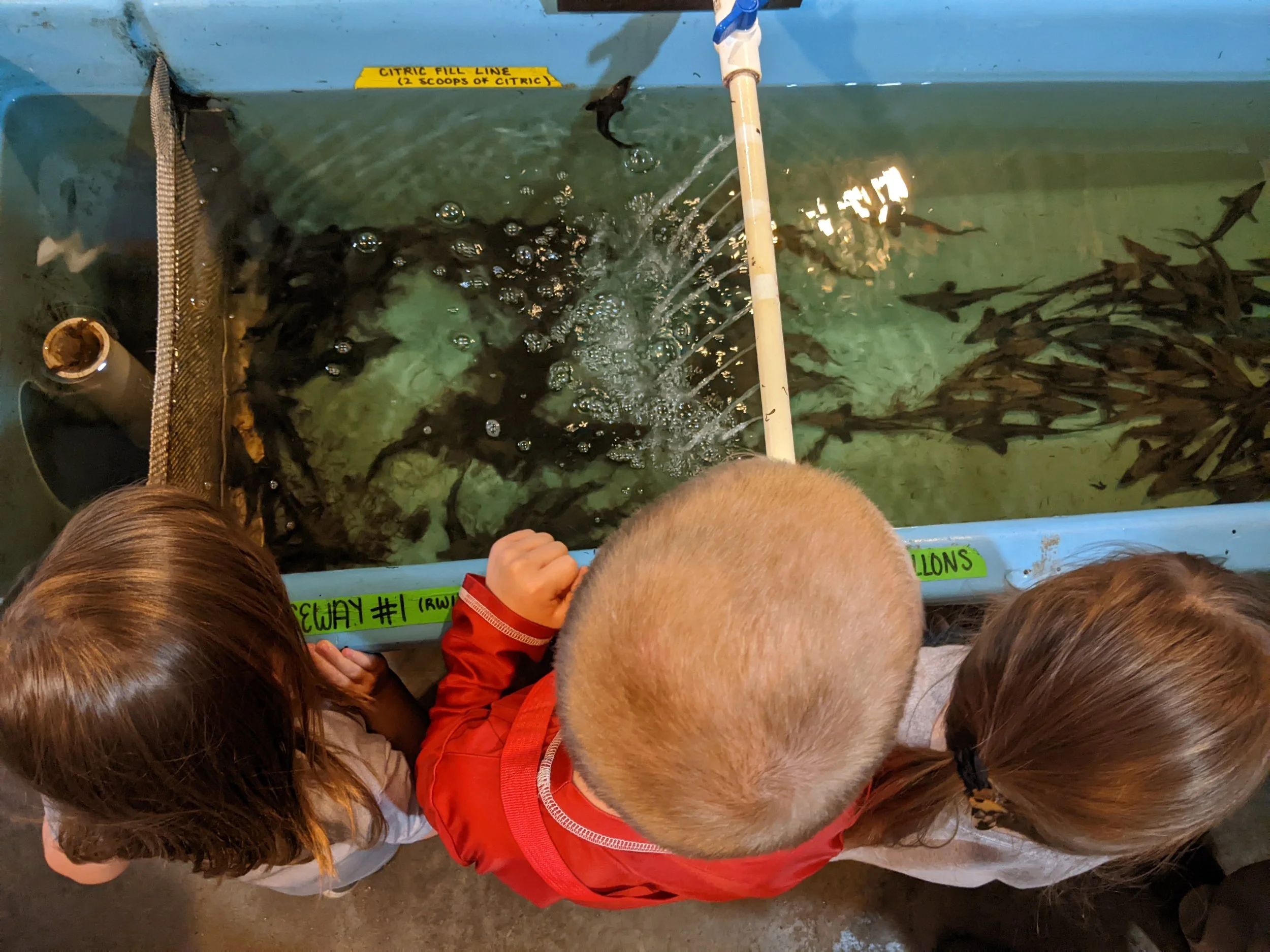

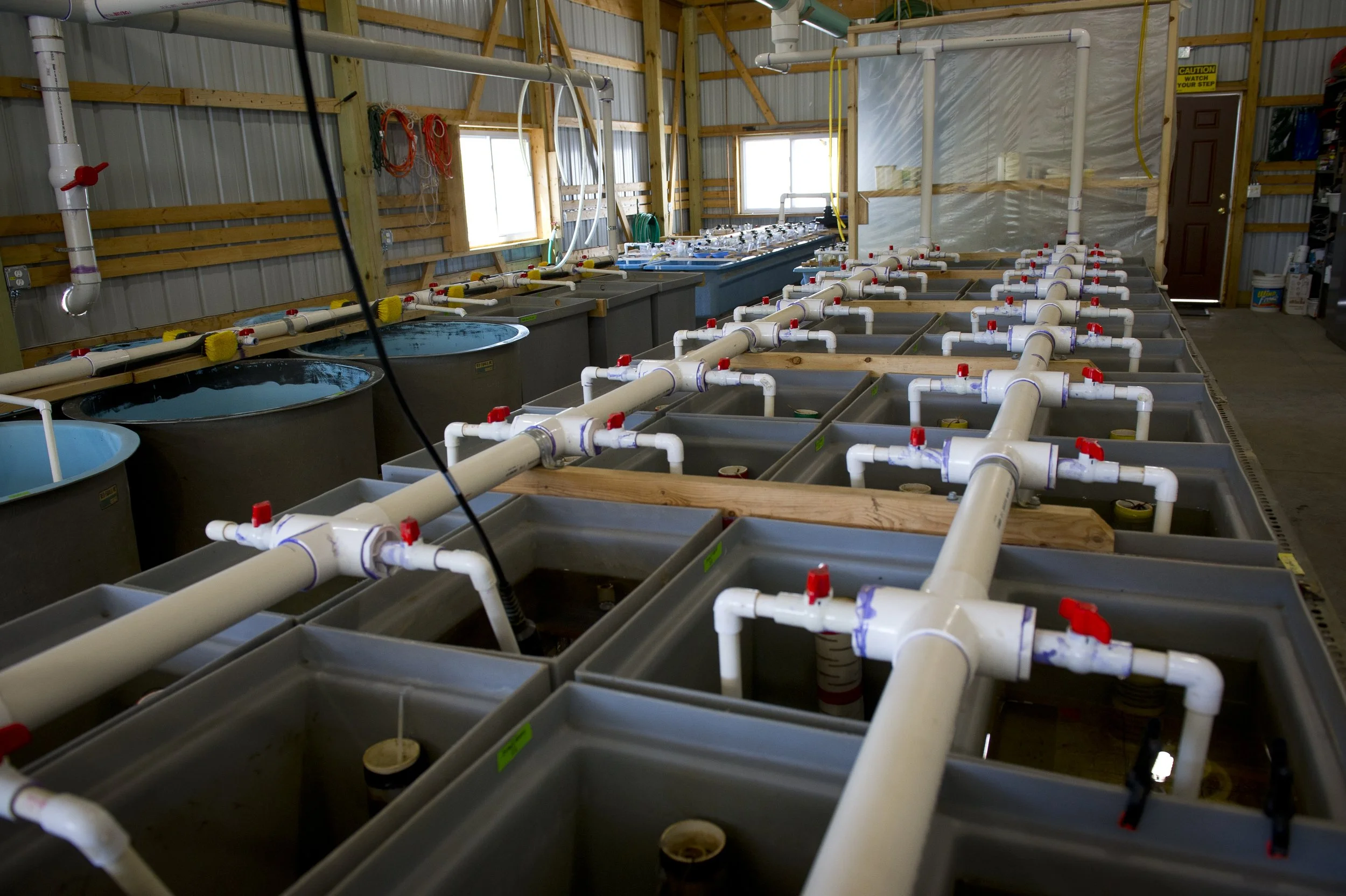
(Photos courtesy of Michigan DNR archives and Sturgeon for Tomorrow)
The sturgeon faced a unique and challenging battle for its restoration. The decline was beyond overfishing and was accelerated by dams, habitat destruction, and having long reproduction cycles. This was at a time where the development of the Great Lakes region was fueled by the timber and agriculture industry. Early clearing and plowing of Michigan's land washed fine particles of the earth into rivers that would enable the suffocation of eggs, destruction of food web (macroinvertibrates), and thermal/chemical pollution. Logs would be sent down river by the thousands to sawmills, scraping the bottom and damaging the gravel and integrity for sturgeon eggs to connect to. Dams were built on rivers for multiple reasons to support civil structure for industry and towns. While some dams were constructed to generate electricity, splash dams were built to hold back water and release suddenly to create a push of water downstream to move logs. These repetitive floods scoured the riverbed and destroyed the gravel needed for sturgeon to spawn.
Breaking down the biology, the spawning characteristics of sturgeon is truly unique. They do not reproduce like other fish annually and they take longer to reach sexual maturity. Males typically reach sexual maturity between 8 and 12 years, while females don't begin breeding until they are 14 to 33 years old, most commonly around age 25. Reproduction is an infrequent commitment; males spawn roughly every 2 to 7 years, while females may spawn only once every 4 to 9 years. It is estimated that roughly 10-20% of the population of adult lake sturgeon are sexually active during a given season. Females are heavier and longer compared to males. The average number of eggs deposited by a female will be roughly 11,000 per kilo, meaning a moderate-sized 60 pounder will drop almost 300,000 eggs.

Sturgeon for Tomorrow is a non-profit organization of volunteers dedicated to protecting and restoring the lake sturgeon population through habitat conservation, public education, and research. The Black Lake chapter was founded in 1999 by local citizens who were determined to save these fish after a 1997 study revealed the population had plummeted by 66%. They took action to prevent a total ban on sturgeon fishing by creating a "Sturgeon Guard" to stop poachers and by building a hatchery to help the species recover. Sturgeon for Tomorrow has led projects like building a streamside hatchery, creating a "Sturgeon Guard" to stop poachers, and bringing live fish into local classrooms to teach students about conservation.
The sturgeon population has bounced back from a 66% decline in the late 1990s to a stable, growing community today thanks to the partnership between volunteers, scientists, and local tribes who have protected and restocked the lake for over 25 years.
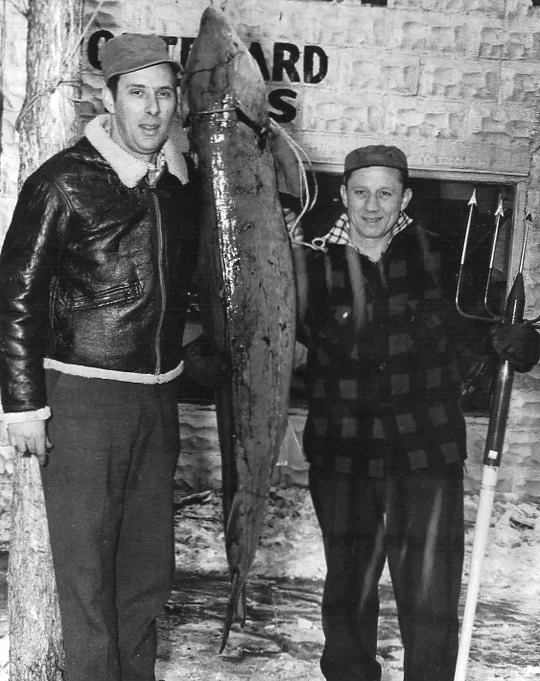
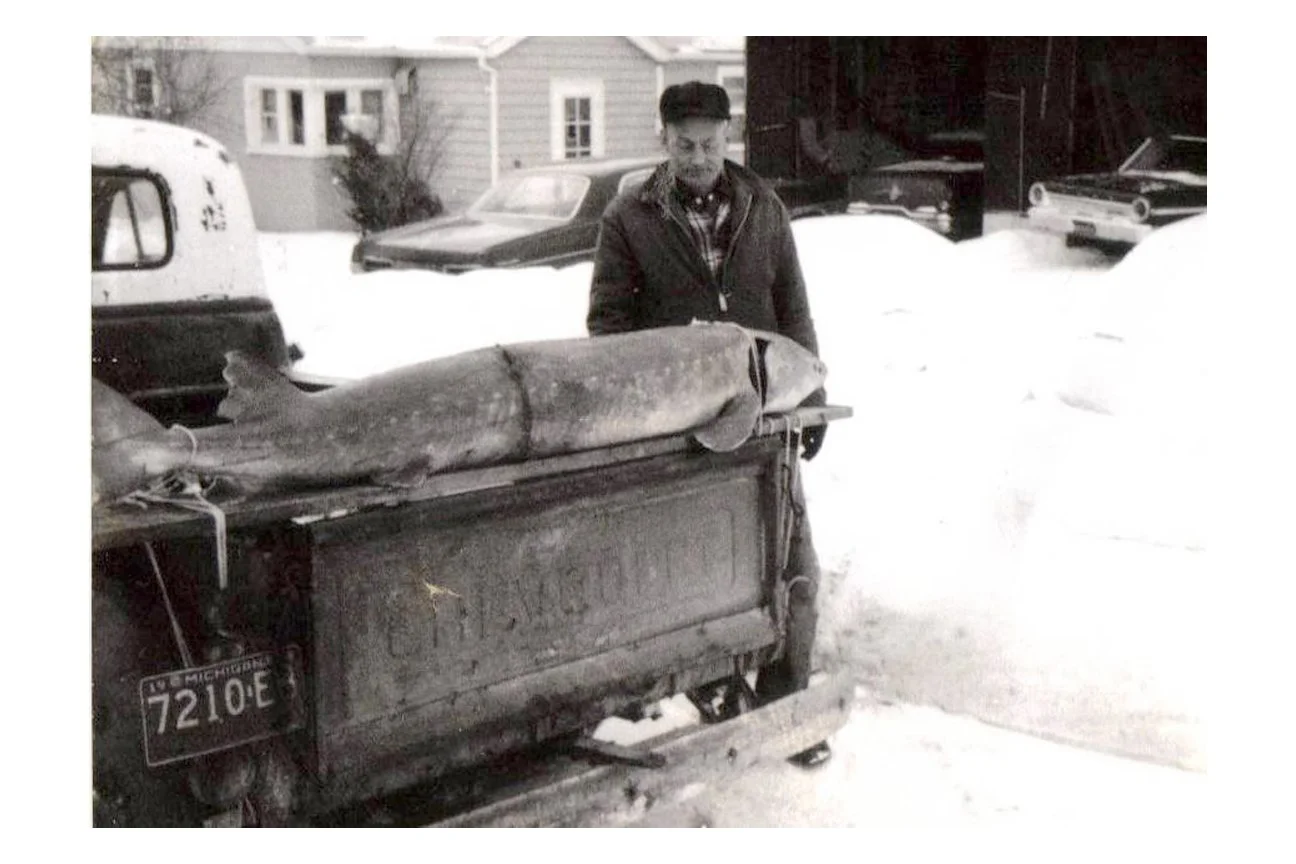
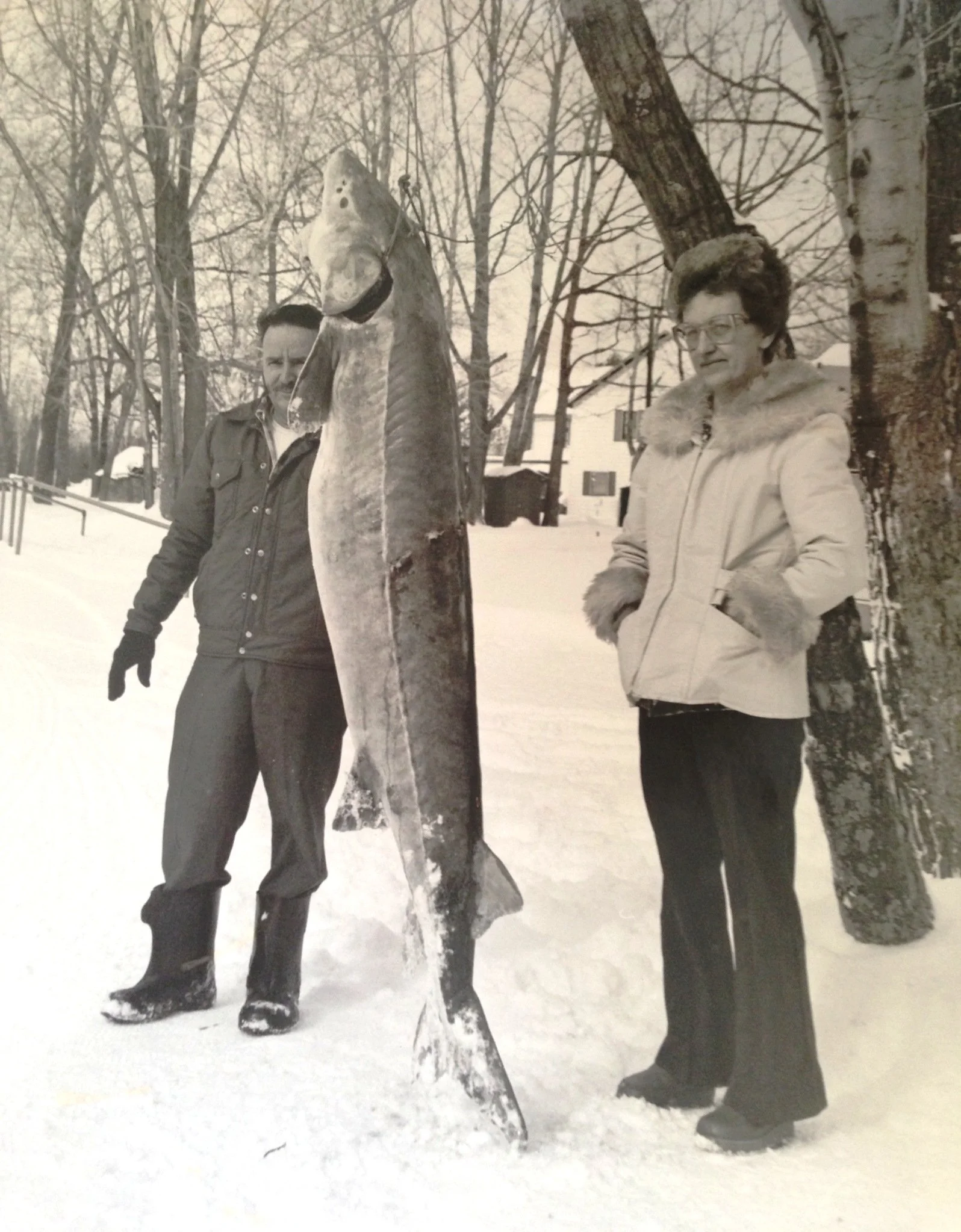
Photos like these above can be found on the walls at the Thirst Sturgeon restaurant in Wolverine, Michigan. They tell a story of tradition around these magnificent fish in northern Michigan. (Photos courtesy of Sheryl Marsh, owner of the Thirsty Sturgeon)
The restoration of the Black Lake Sturgeon is a collaborative success story where Sturgeon for Tomorrow, the Michigan Dept. of Natural Resources, Michigan State University, the Chippewa Ottawa Resource Authority, and Tower-Kleber limited partnership. Together, they combine their skills and knowledge to sustain the future of sturgeon in this area of northern Michigan.
“The sturgeon fishing season on Black Lake may be brief but Michigan DNR Fisheries Division puts a great deal of time and thought into the management of it both before and during season. The history of management of the season has been a collaborative goal of both DNR and the local Sturgeon For Tomorrow public chapter. We are anticipating a larger gathering again this season.”
In a world of elaborate dark houses, bath tub-sized holes, special decoys, wide multi-prong spears, and (often) a lucky charm or two. Everything about this is super-sized and specialized. When you look at the gear and operation, there is no doubt what their objective is.
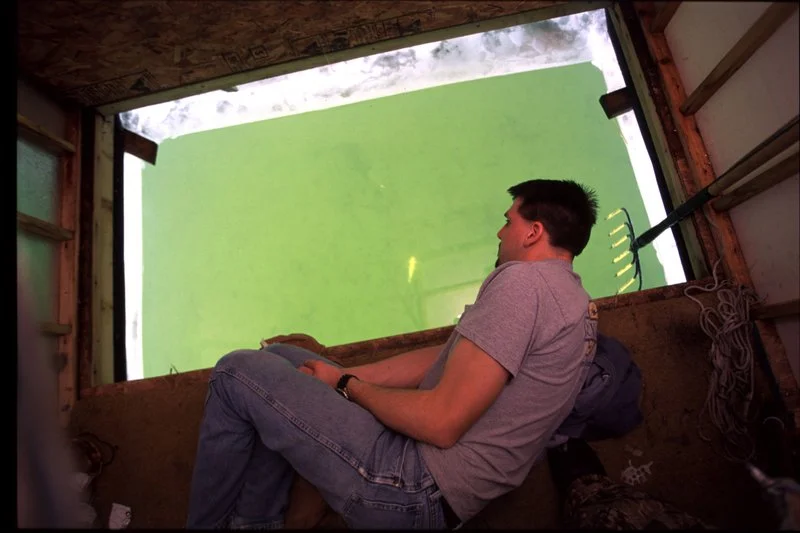
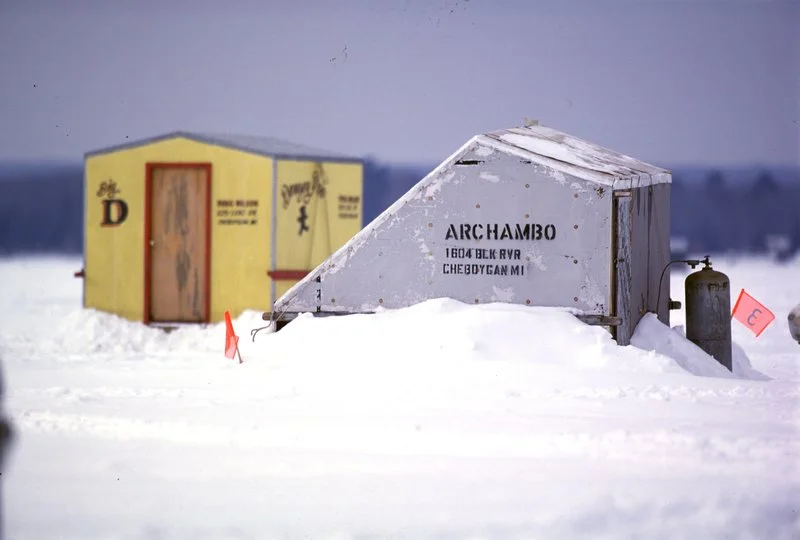
(Photos courtesy of Michigan DNR archives)
Sturgeon are curious fish. Decoys are used to draw in their attention, some being more unconventional or ‘lucky’ in nature. These can range from large colorful fish imitators, to coffee mugs, to metallic frying pans, to glitter bowling balls or pins, and even glow in the dark toilet seats.
Whether you call it a shanty or a shack, the term ‘dark house’ refers to a specialized ice fishing shelter. Homemade and designed with spearing in mind, dark houses are built with a construction so that no light can enter and with a floor plan for a large hole. If done right and in clear water, the bottom can be seen in depths of 15-20’ beyond.
While these fish feed off the bottom, they are not always hanging out down low. Sturgeon will occupy the water column and suspend. This adds a level of challenge after a fish has been speared. With a thrashing giant on the end of a line, it must be brought in quickly before getting off. A second spear is sometimes deployed to assist in bringing these fish close enough to being gaffed.
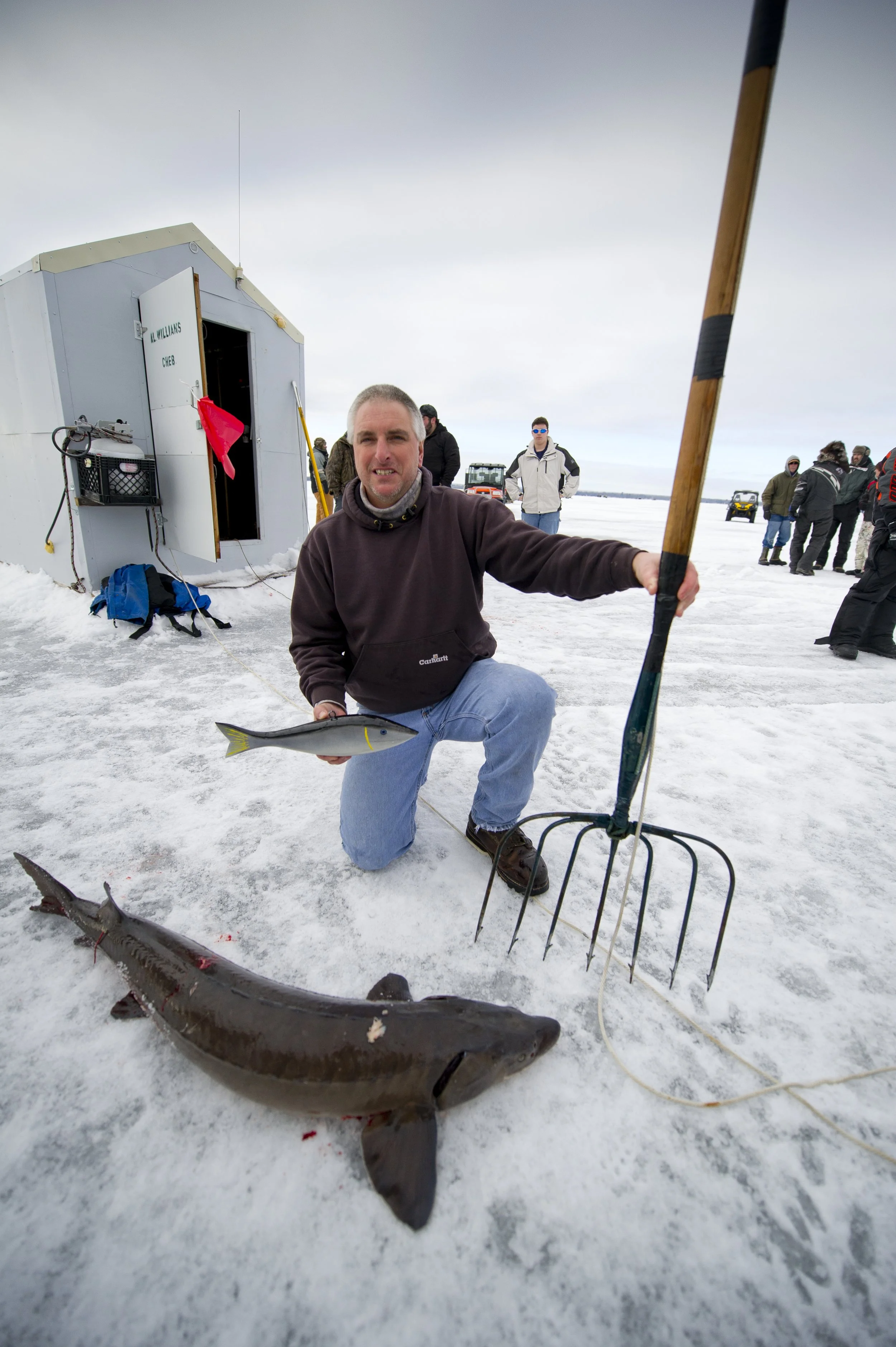
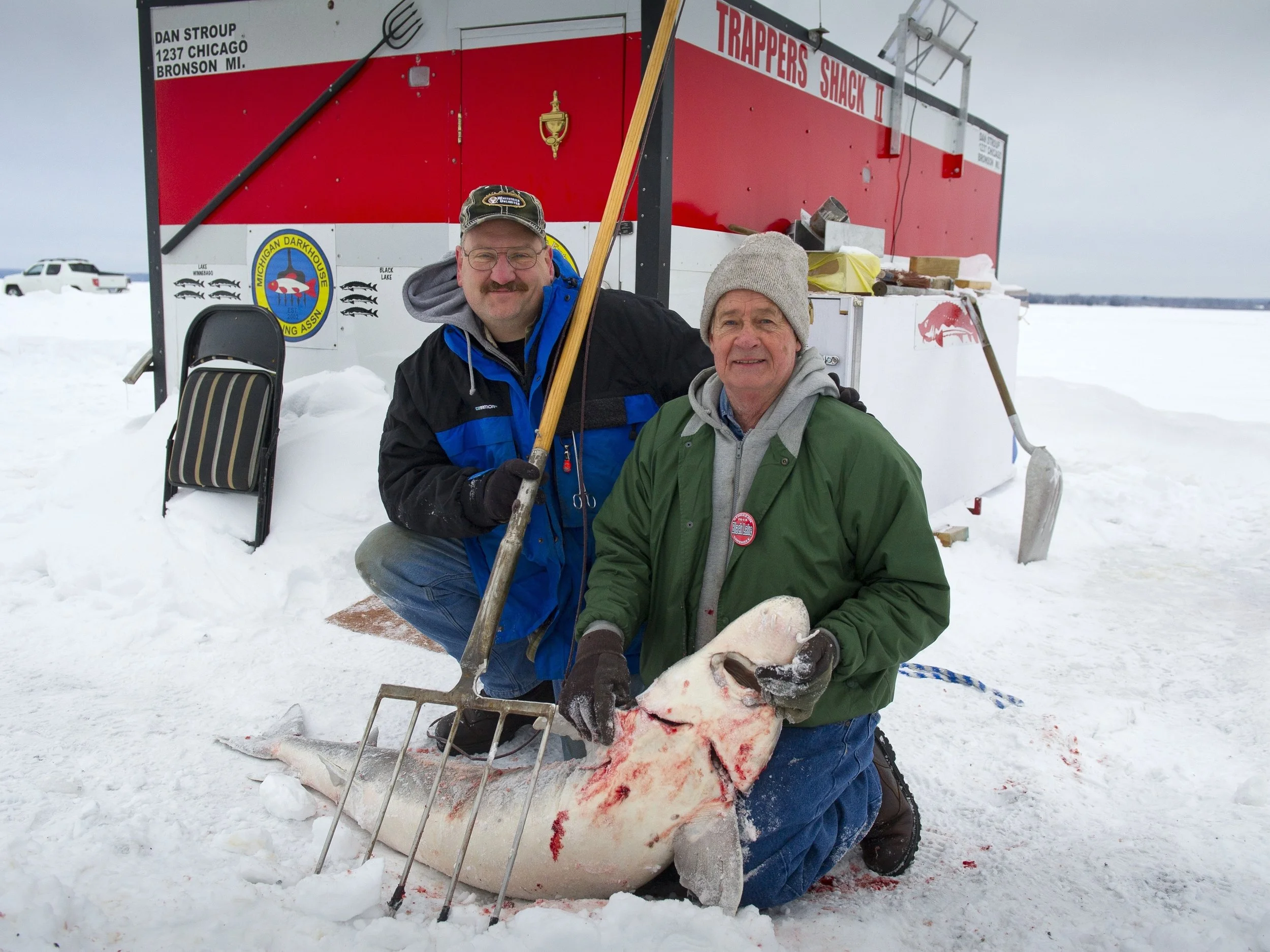
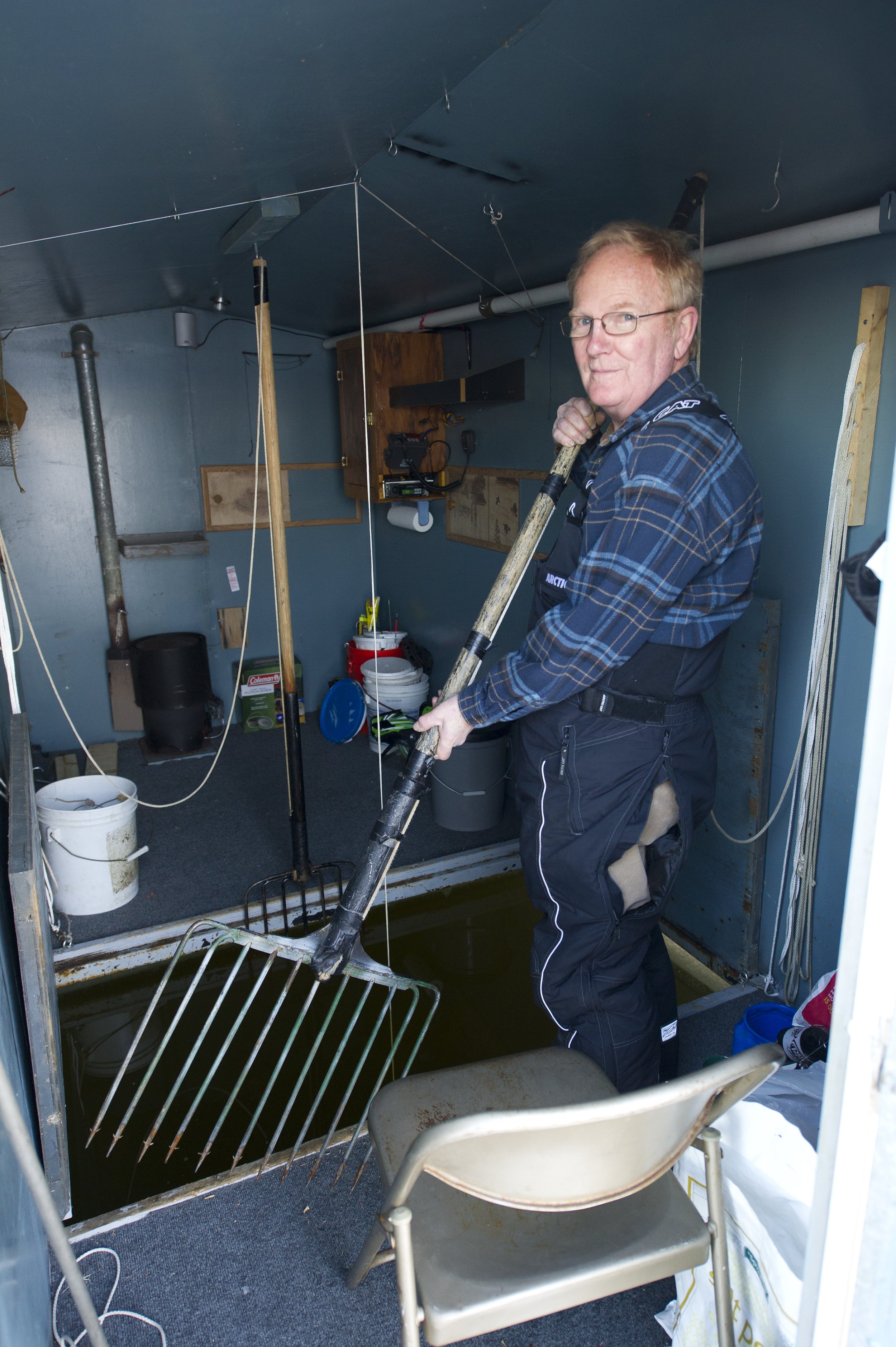
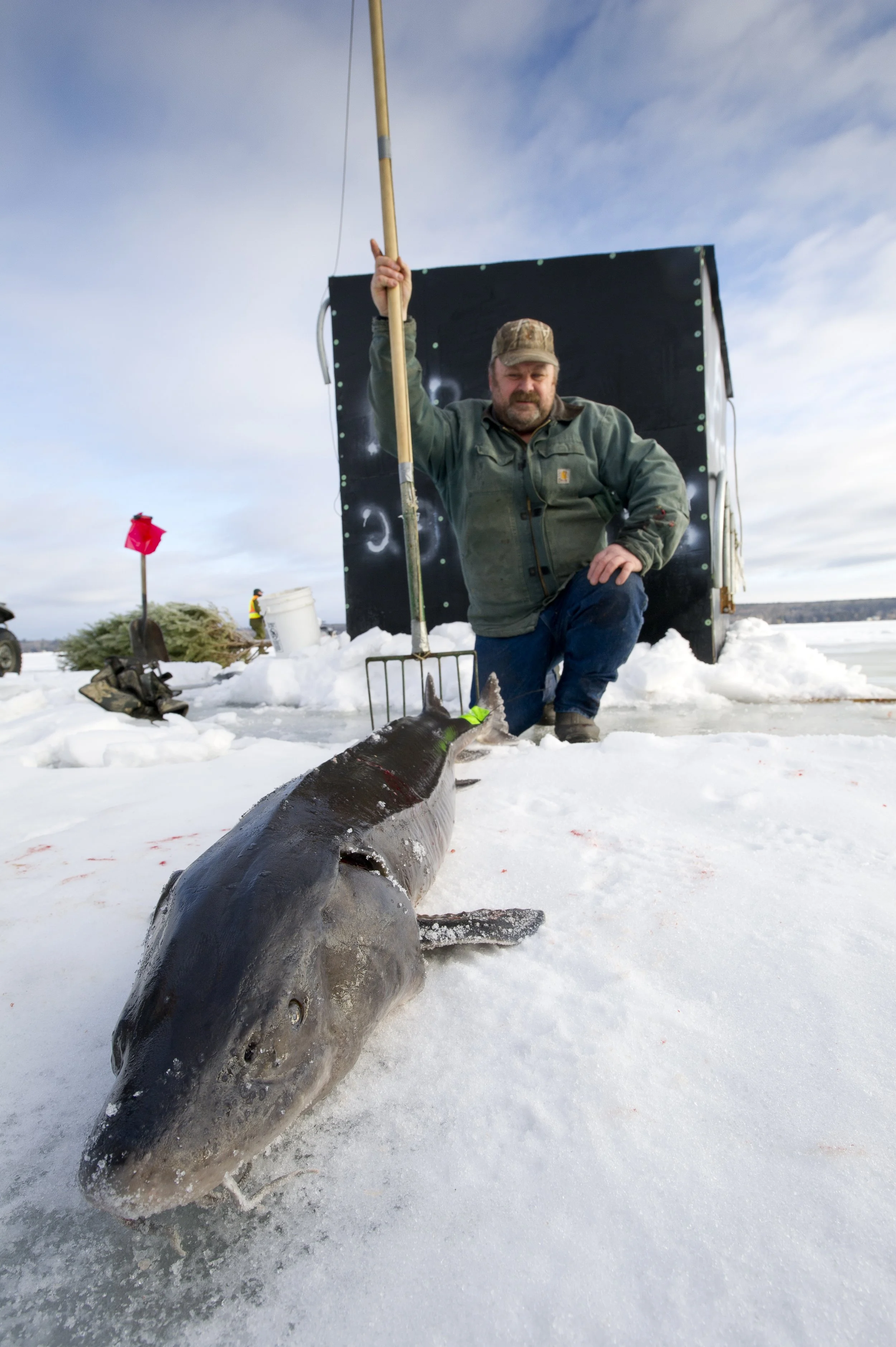
Above: Big fish mean BIG business. When you see the gear and work that goes into sturgeon spearing, there is no mistaking what they are after. (Photos courtesy of Michigan DNR archives)
Before the spear can be thrown, a hole must be cut. A chainsaw or ice saw is used to effectively cut a large enough rectangle. The work that goes into sturgeon spearing is a labor of love and dedication. Days before the event, shacks will be set in place and the hole will be carved. People describe the sport as being similar to deer hunting because of the preparation work that goes into it before one can spend time sitting and waiting for their opportunity to throw and connect with a trophy and memory.
How the season works:
To participate in the 2026 Black Lake sturgeon spearing season in Michigan, a couple of tasks have to be completed before the season begins.
Beforehand:
Valid Fishing License: If you are 17 or older, you must have a current Michigan fishing license. You should purchase this before attempting to register for the sturgeon season. Licenses can be purchased here.
Online Registration: All participants must register online at Michigan.gov/Sturgeon. For the 2026 season, registration must be completed by the close of business on Friday, Feb. 6. This must be done online- there will be no registration on site.
Cell Phone Number: You must provide a valid cell phone number during registration. This is used by the DNR to send text alerts when the harvest limit is reached and the season is officially closed.
On the ice:
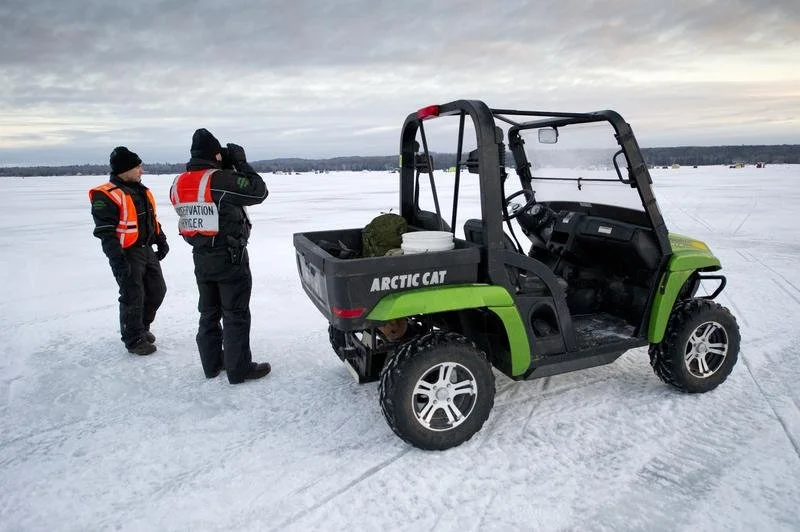
Conservation officers for the Michigan DNR will be on the ice supervising the event.
Bright Red Flag: You must bring a bright red flag that is at minimum 1 foot diameter to hang on your fishing shanty. This must be in a highly visible location so DNR personnel can identify active sturgeon anglers.
Immediate Reporting: If you harvest a fish, you must immediately contact DNR personnel on the ice. Official registration and biological sampling take place at the DNR trailer located at the end of Zollner Road.
Daily Hours: Fishing is only permitted from 8:00 a.m. to 2:00 p.m. if the quota has not been met.
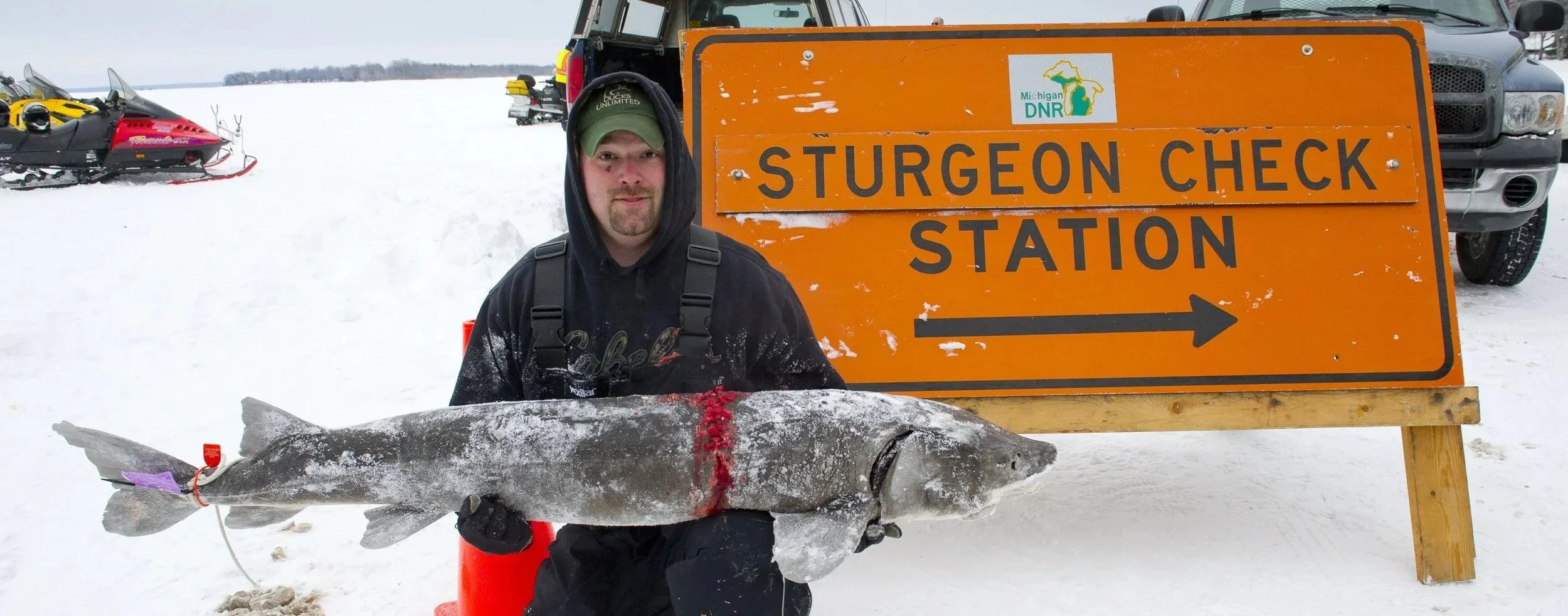
(Photo Courtesy of Michigan Dept. of Natural Resources)
Be there and be ready:
The season is scheduled to open at 8:00 a.m. on Saturday, February the 7th. If you are going, be there and be ready- the opportunity passes quickly! In 2025, the season was over in 17 minutes with nearly 800 registered anglers.
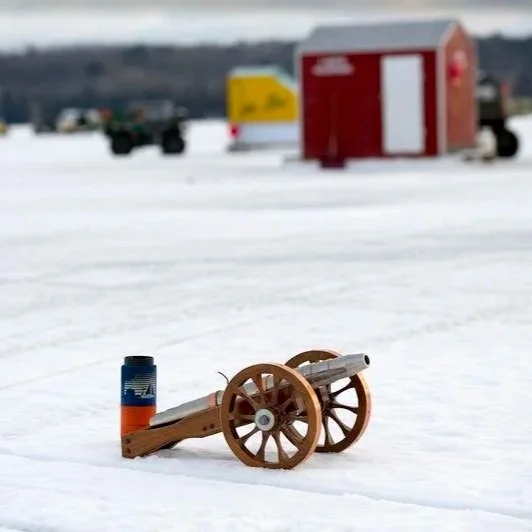
While the season is posted as February 7th to 11th, if only five fish are harvested by the end of a fishing day, the season will then be closed. This is to protect from going over the six fish quota when you have an army of people on ice looking for a chance at connecting with a trophy.
When the quota is reached, a final text message alert will go out notifying those registered that the season is closed. Additionally, a siren will sound off and a cannon will be fired. With 700 participants already registered and a forecast of clear water, the season is not expected to last long. Although being a short window, the draw of the sport and chance to be of the few to harvest one of these fish keeps bringing people back as dedicated enthusiasts.
For those who are fortunate to see their hard work pay off and put one of these fish on the ice, anglers need to immediately notify a DNR agent. If personnel are unable to be found quickly on the ice, they must call 231-340-0276.
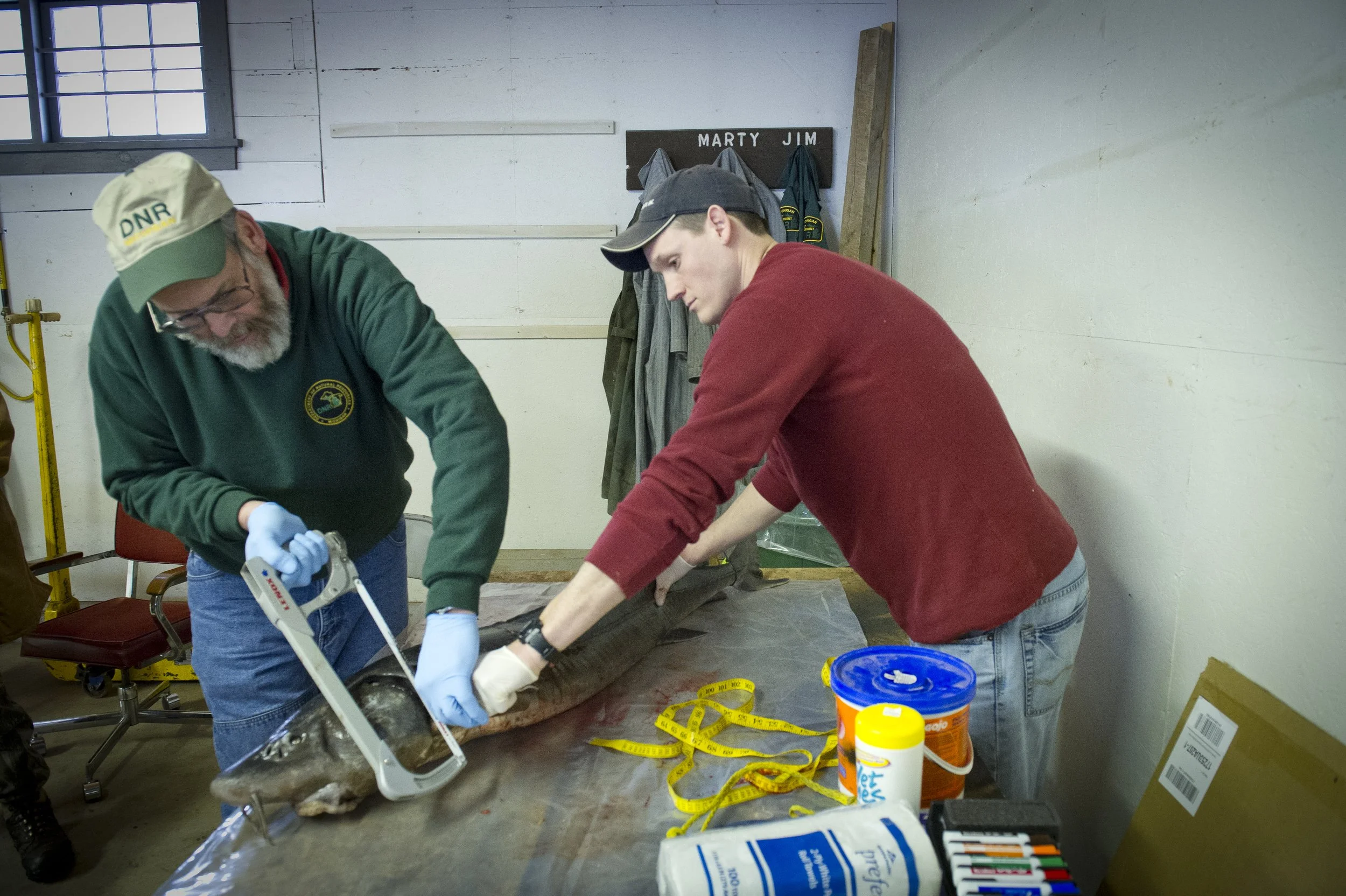
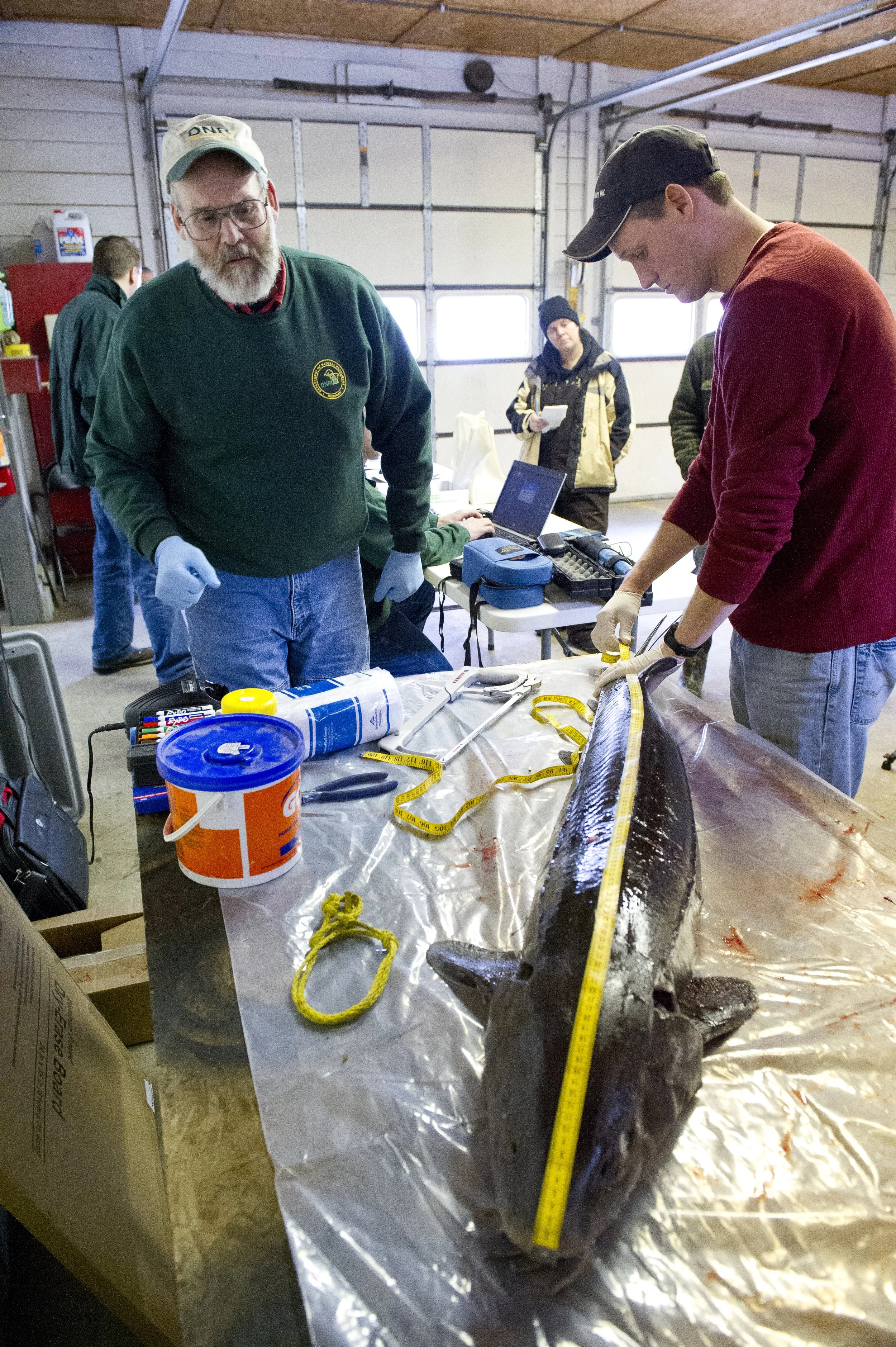
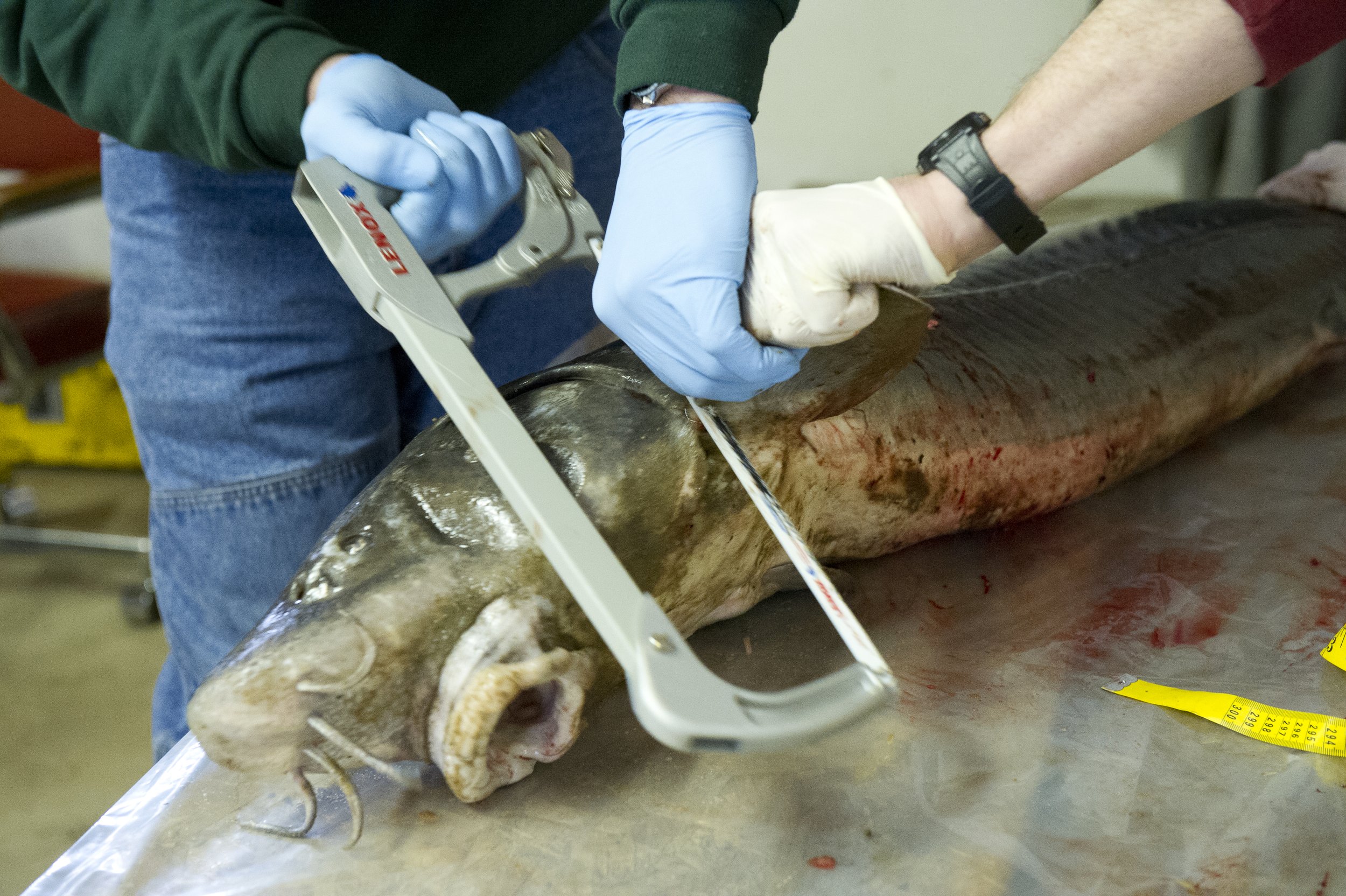
(Photos Courtesy of Michigan Dept. of Natural Resources archive)
Successful anglers must then immediately take the fish to be registered at the DNR trailer at the Zolner Road access located at the northwest side of the lake. Biologists record the fish’s weight and measurements, scan for internal microchips (PIT tags) to track its history, and perform an internal exam to determine its sex and reproductive status. To assist with long-term research, they also collect a fin tissue sample for DNA testing and may take a fin ray cross-section to accurately determine the fish’s age. This data is critical for monitoring the success of local stocking efforts and setting the harvest quotas that keep the population sustainable.

The Black Lake Stugeon Shivaree, a Celebration of the Season
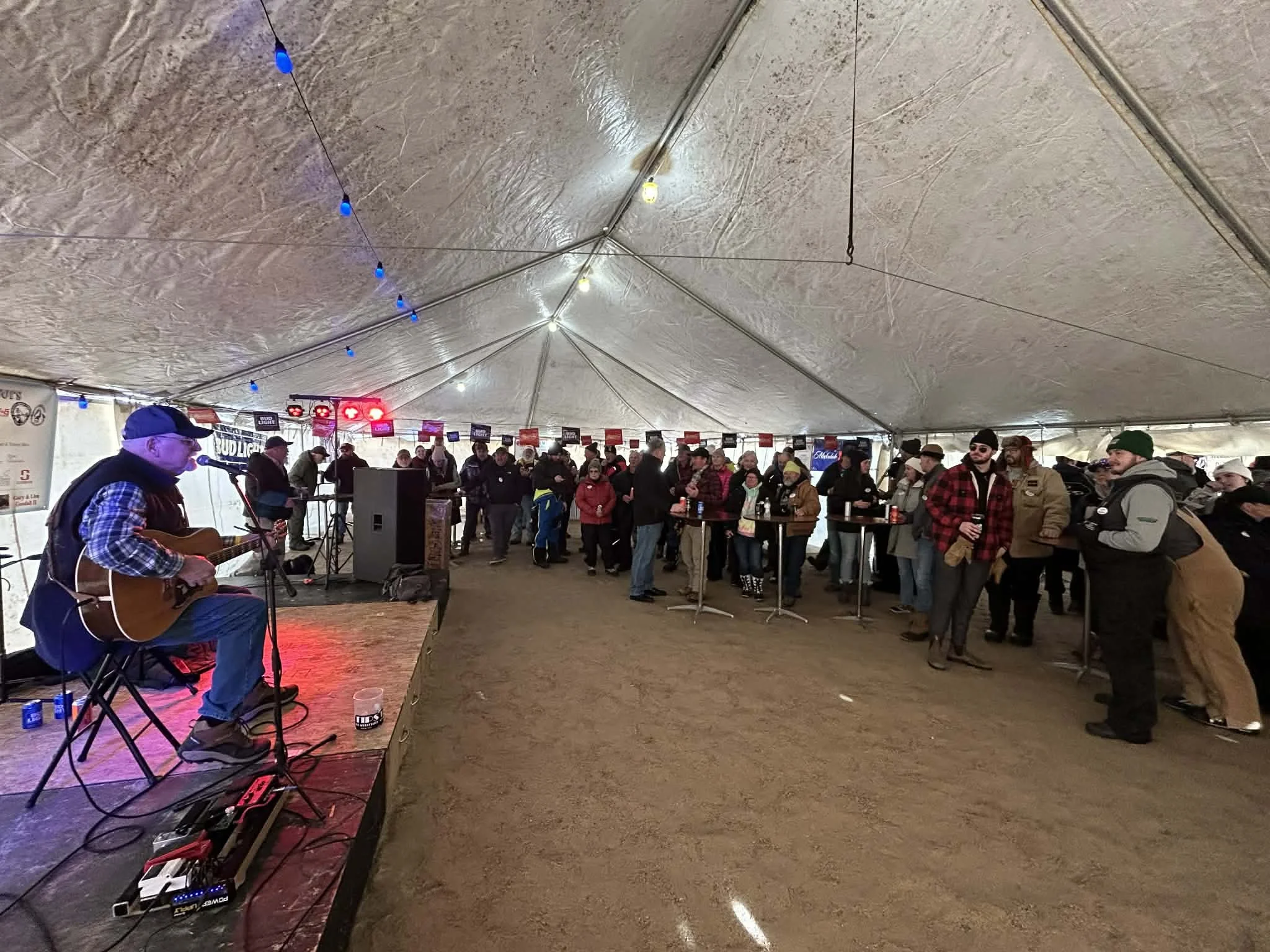

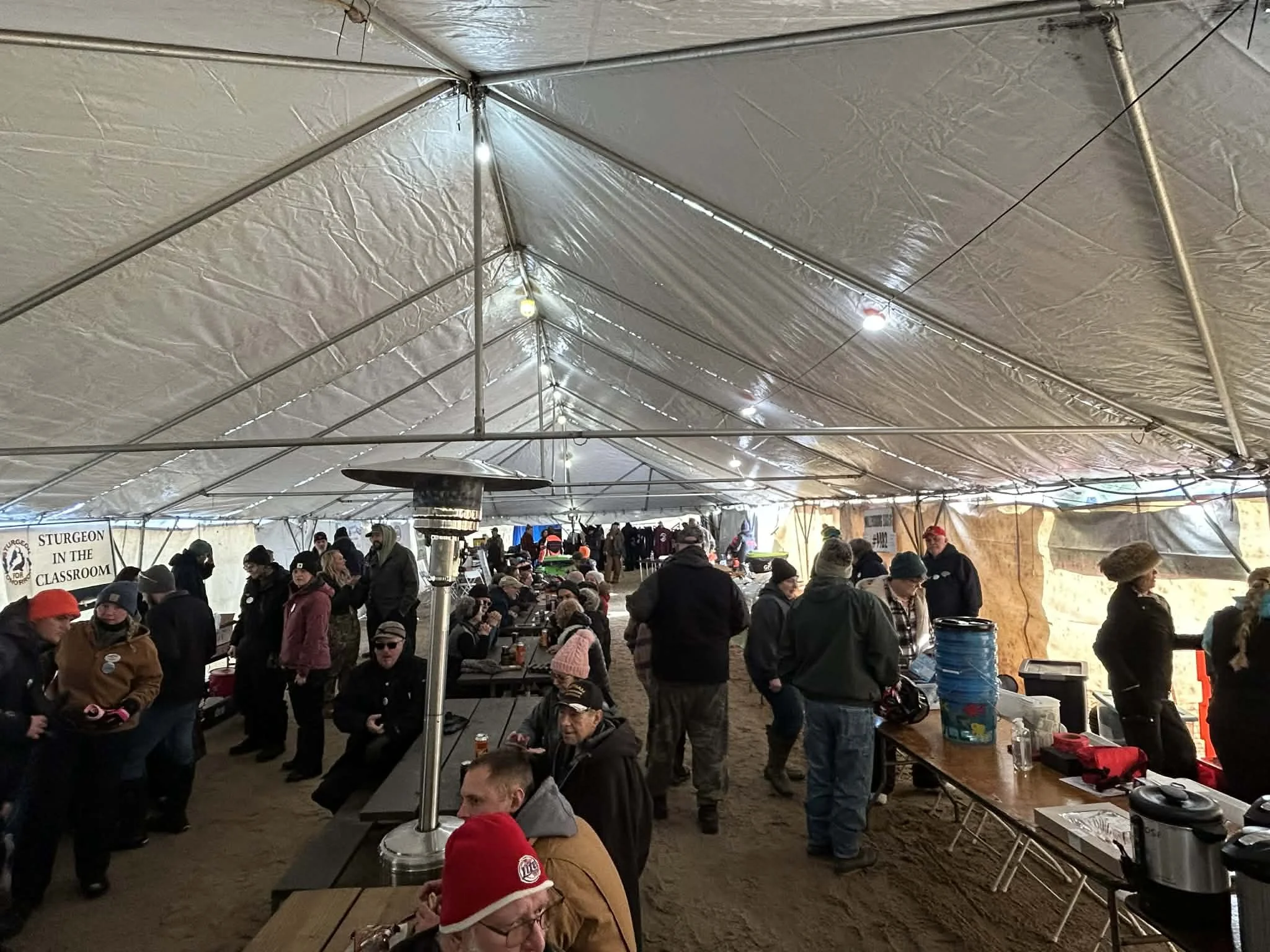
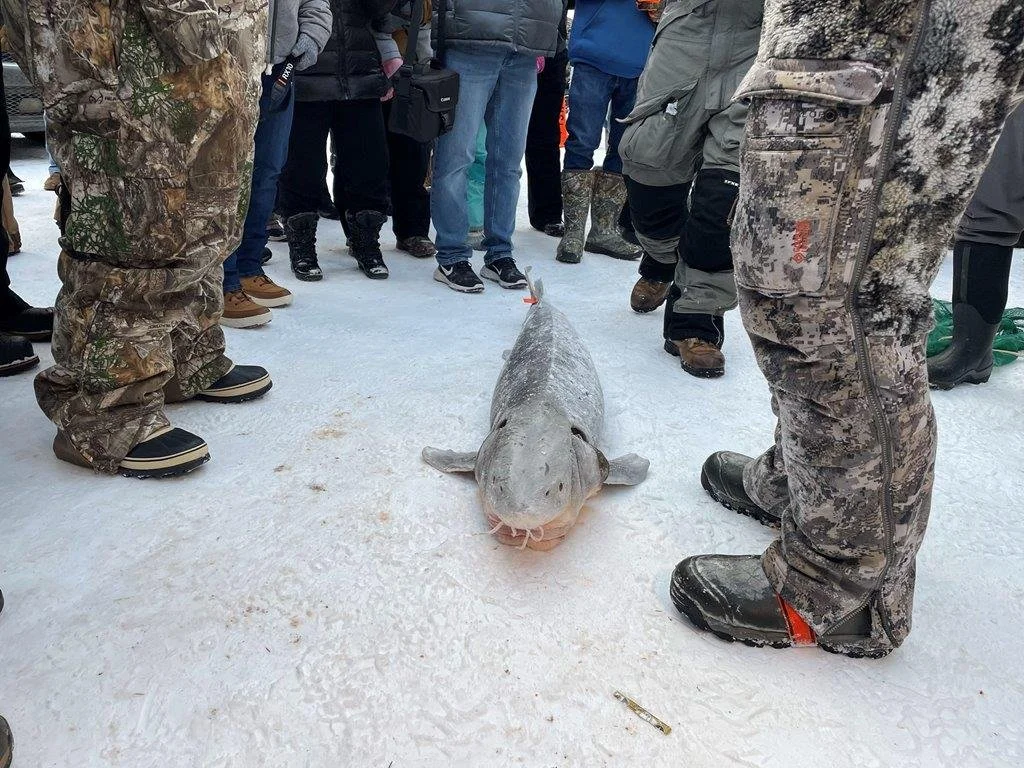
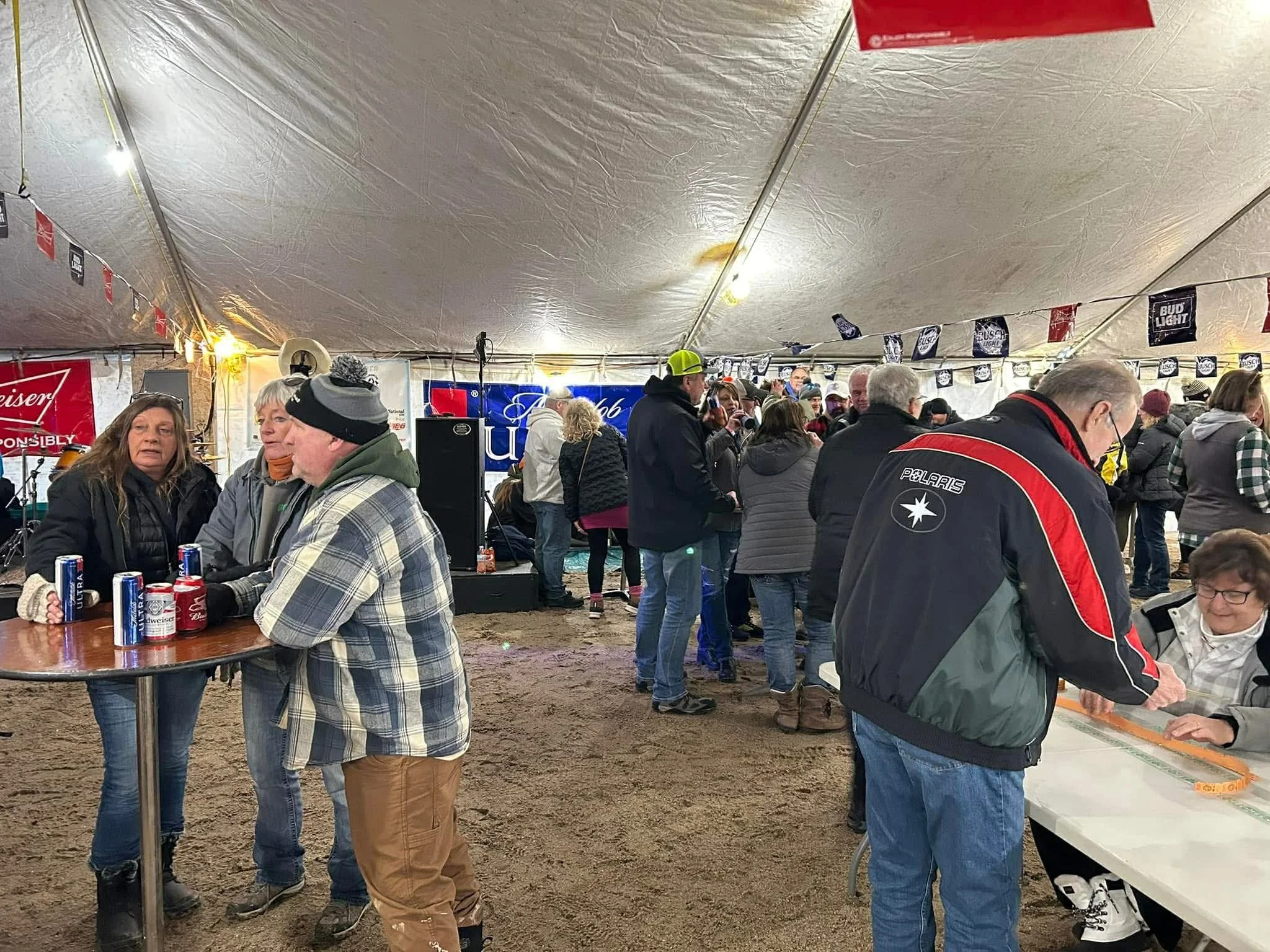
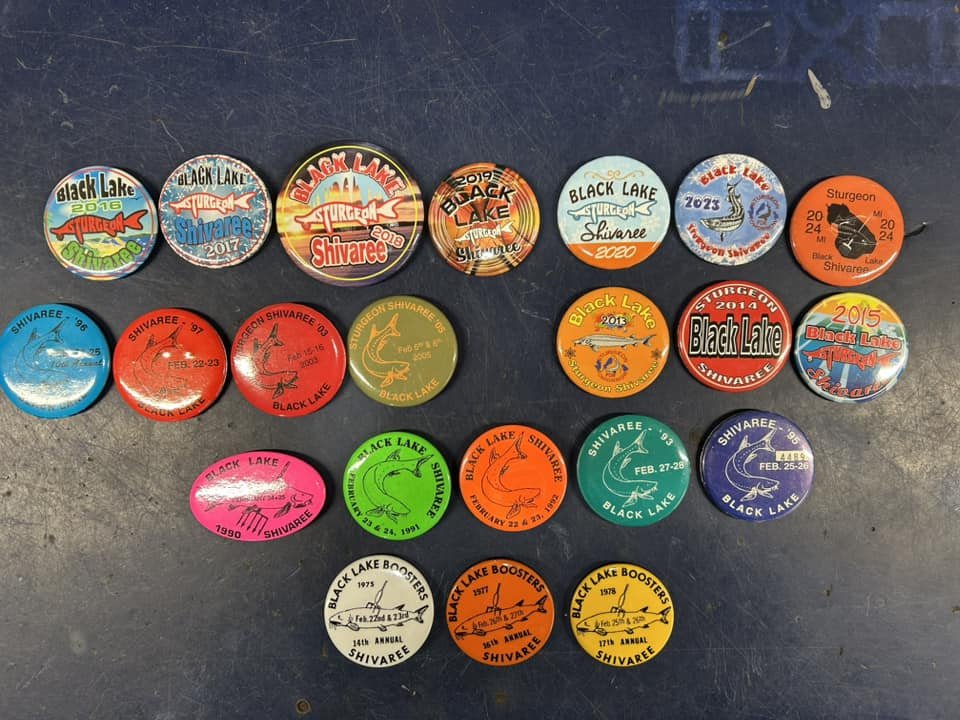
The Black Lake Sturgeon Shivaree is an annual winter festival held in early February on Michigan's Black Lake. This is a winter festival to celebrate the season, bring the community together, and raise support for projects of Sturgeon for Tomorrow chapter. From all of the reviews, the consensus is that this a celebration you do not want to miss! Everybody is invited for the party at 1701 Winifred Street, Cheboygan, MI. 49721. Admission is $5 and includes a collectible Shivaree button.
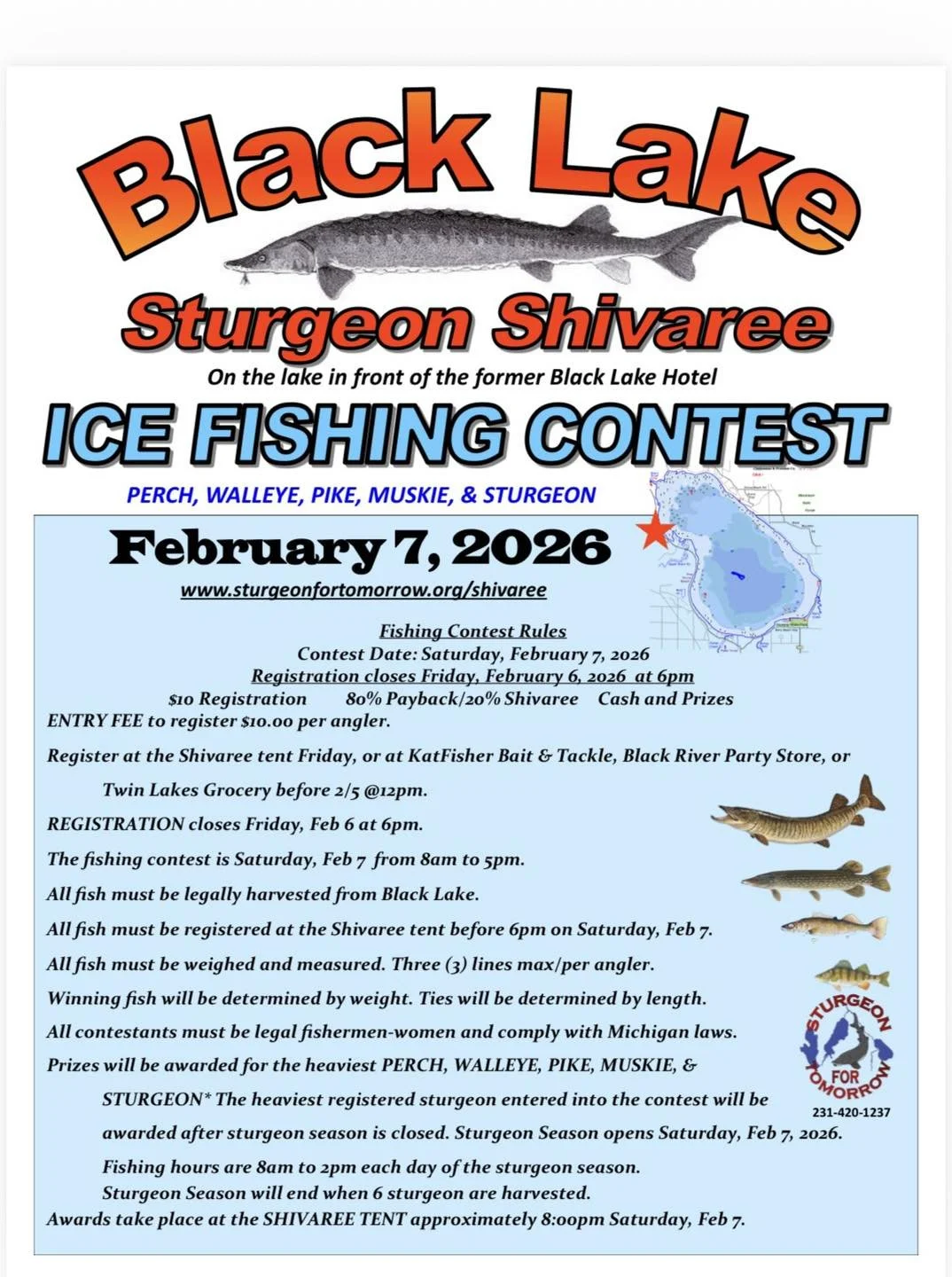
For those looking for a good time, this event includes a fishing contest, live entertainment, poker run, beer tent, raffles, food, and children's events. The individual who spears the biggest sturgeon will be crowned as The Black Lake Shivaree Sturgeon King/Queen. This celebration has something for everybody with a great time for the whole family!
Additionally, the economic impact for communities surrounding this event is tremendous during this time of year. These towns in Northern Michigan need support during the slower seasons to keep businesses and the local economy growing. When you support small, independent, local business, everybody wins.


A Bright Future Ahead
Through hard work and dedication in conservation efforts, the future of the sturgeon in the Black Lake and Cheboygan Watershed is looking bright. In 1997, it was estimated that 500 breeding adults were in Black Lake, while estimates today support more than 1,200. In 2023, a survey found that not all young fish were from the hatchery, demonstrating natural reproduction in the wild.
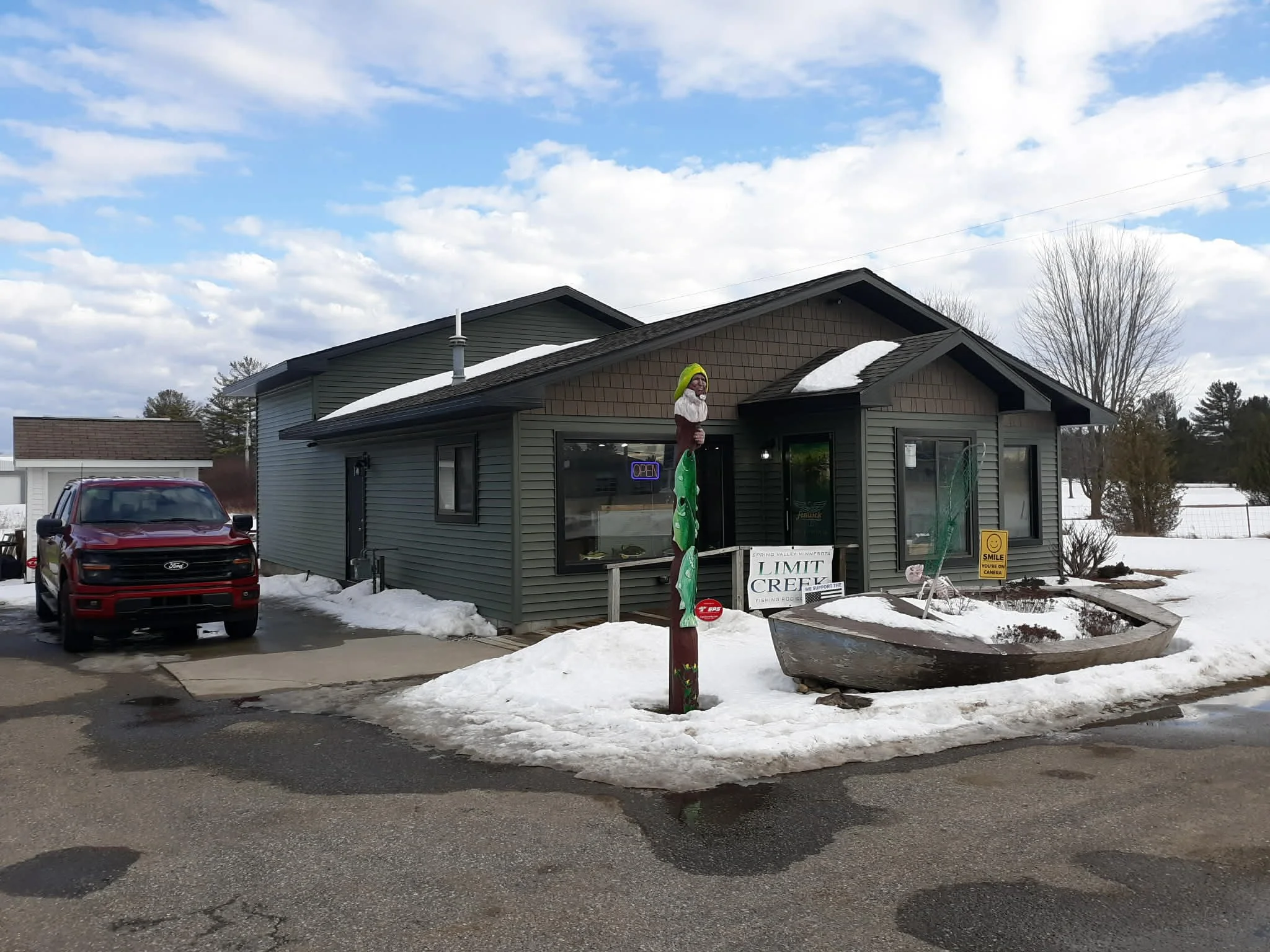
Katfisher Bait and Tackle: +1 231-420-6024
Whether you are planning to visit Black Lake for the Sturgeon Spearing season or fishing any of the lakes in northern lower Michigan whenever, please visit Katfisher Bait and Tackle, located at 9872 N Straits Hwy, Cheboygan, MI, 49721. They provide a wonderful array of bait and tackle you may need, along with friendly and helpful advice for those visiting the area. 7am-5pm, 7 days a week.
A special word of appreciation is shared for Jay Woiderski of Sturgeon for Tomorrow for sharing his family story and his hard work, dedication, and stewardship.
Additional appreciation is expressed for the Michigan Dept. of Natural Resources, Sheryl Marsh of the Thirsty Sturgeon restaurant, Michigan State University Fisheries Dept., and the Chippewa Ottawa Resource Authority, for their contributions not only to this article, but the future of the Sturgeon.